
Pakistan’s Saudi Defence Pact: Why the 2015 Argument Falls Short
The real question is not why Parliament voted in 2015 but did not vote in 2026. It is whether the two military missions were ever comparable in the first place.

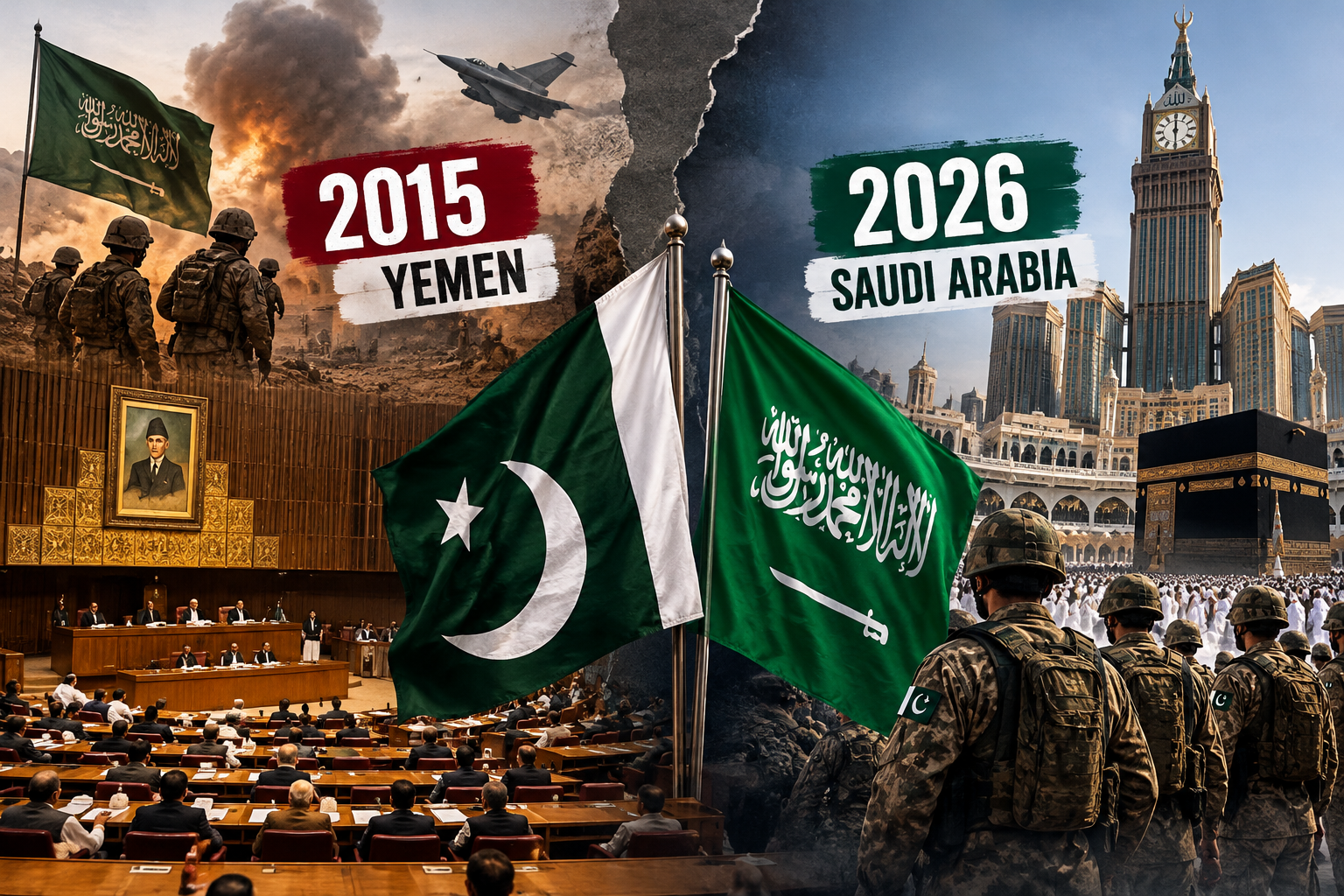
Comparing Pakistan’s 2015 parliamentary decision to maintain neutrality in the Yemen conflict with its 2026 commitment to deploy additional forces to Saudi Arabia overlooks fundamental differences in the nature, purpose and legal framework of the two military commitments.
An analysis by PPC Digital of the historical parliamentary record, Pakistan’s defence policy, subsequent regional defence agreements and constitutional developments finds that the comparison fails to distinguish between participation in an external military intervention and the defence of an allied country.
The central question is whether Pakistan’s position in 2026 represents a departure from the policy adopted in 2015, or whether the two decisions concern fundamentally different military circumstances.
The historical record offers important context.
What Pakistan’s Parliament Actually Decided in 2015
On April 10, 2015, a joint session of Pakistan’s Parliament unanimously adopted a resolution calling for neutrality in the Yemen conflict, following extensive debate over Saudi Arabia’s request for military assistance.
The Saudi-led coalition had launched military operations against the Houthis in March 2015, and Pakistan was approached for military support, reportedly including ground troops, fighter aircraft and naval assets.
The parliamentary resolution called for Pakistan to remain neutral in the Yemen conflict to facilitate a diplomatic settlement. However, it also explicitly reaffirmed Pakistan’s commitment to Saudi Arabia’s sovereignty, territorial integrity and the security of the holy sites.
Parliament expressed unequivocal support for Saudi Arabia, stating that Pakistan would stand shoulder to shoulder with the Kingdom in the event of any threat to its territorial integrity or sovereignty.
This distinction is particularly significant.
The 2015 parliamentary resolution addressed Pakistan’s potential involvement in military operations inside Yemen. It did not rule out Pakistan’s participation in the defence of Saudi Arabia against external aggression.
In other words, the resolution distinguished between entering an ongoing conflict in another country and fulfilling defence commitments to a longstanding strategic partner.
From Yemen 2015 to Saudi Defence Pact 2026: What Changed?
Eleven years later, Pakistan’s defence relationship with Saudi Arabia operates under a different institutional framework.
In September 2025, Pakistan and Saudi Arabia formalised their bilateral defence cooperation through an agreement described by both countries as defensive rather than offensive in nature.
The subsequent Makkah Joint Defence Agreement involving Pakistan, Saudi Arabia and Türkiye further strengthened collective security cooperation, military coordination, intelligence sharing and joint responses to emerging threats.
The trilateral arrangement is designed to strengthen the defensive capabilities of the participating countries rather than establish a framework for offensive military operations against another state.
Turkish Foreign Minister Hakan Fidan recently reiterated that the Makkah defence arrangement is defensive in nature and not intended for offensive military action.
The Pakistani side has also previously clarified the defensive nature of its security commitments to Saudi Arabia.
Against this background, the reported 2026 commitment to rapidly deploy additional Pakistani forces to Saudi Arabia must be examined in the context of the stated objectives of these defence agreements.
Unlike the 2015 situation, which concerned potential participation in military operations inside Yemen, the present arrangement concerns the defence of Saudi Arabia under an established collective security framework.
The objectives, operational circumstances and strategic commitments are therefore not identical.
Pakistan’s Defensive Policy: From India to Afghanistan
Pakistan’s broader security doctrine provides further context to this distinction.
Pakistan has consistently maintained a state policy of avoiding offensive military action against other countries, including states with which it has longstanding security disputes.
In its military confrontations with India, Islamabad has characterised its strikes as defensive responses to Indian aggression, undertaken to protect its sovereignty and territorial integrity rather than initiate hostilities.
Similarly, Pakistan has faced persistent terrorism emanating from Afghan territory. When intelligence and evidence identify terrorist sanctuaries and operational infrastructure inside Afghanistan as sources of attacks against Pakistan, Islamabad has described its precision strikes against those locations as defensive measures aimed at neutralising threats to national security.
In both cases, Pakistan has presented the use of military force as an exercise of its right to self-defence rather than a policy of initiating offensive warfare against another sovereign state.
These examples are relevant to understanding the distinction between the stated purpose of military operations and their geographical location. A military action conducted beyond national borders is not necessarily offensive in its strategic purpose simply because it takes place outside the country’s territory.
Under international law, however, the legality of any cross-border use of force depends on the applicable circumstances and requirements governing self-defence.
PPC Digital’s assessment is that this distinction between offensive intervention and defensive military action is essential to understanding Pakistan’s security approach, including its defence cooperation with Saudi Arabia.
How the 27th Constitutional Amendment Changed Article 243
The parliamentary dimension of the comparison also requires closer examination.
In 2015, the government of then-Prime Minister Nawaz Sharif referred the Yemen question to Parliament, which subsequently adopted its unanimous resolution.
However, the constitutional framework governing Pakistan’s armed forces has since undergone significant changes.
The 27th Constitutional Amendment, passed by Parliament and signed into law on November 13, 2025, amended Article 243 of the Constitution, introducing the position of Chief of Defence Forces and restructuring the senior military command arrangements.
The amendment changed the institutional structure of military command, making the constitutional framework in 2026 different from the one that existed during the parliamentary debate in 2015.
Nevertheless, Article 243 continues to place control and command of the armed forces within the constitutional framework of the federal government.
The creation of the Chief of Defence Forces position does not, by itself, transfer constitutional responsibility for foreign policy or overseas military deployments exclusively to the military leadership.
Does Overseas Troop Deployment Require Parliamentary Approval?
Equally important, Pakistan’s Constitution does not establish a general requirement for Parliament to conduct a separate vote before every overseas deployment of the armed forces.
The 2015 parliamentary debate was a significant political and institutional decision concerning Pakistan’s potential participation in an ongoing regional conflict. It should not automatically be treated as a constitutional precedent requiring an identical parliamentary process for every subsequent defence deployment.
The absence of a parliamentary vote in 2026 may raise legitimate questions concerning civilian oversight, transparency and parliamentary scrutiny. However, it does not independently establish that the military has assumed exclusive control of foreign policy or that the deployment lacks constitutional authorisation.
Any such conclusion would require evidence concerning the actual decision-making process, the role of the federal government and the legal authority under which the deployment was approved.
The 27th Amendment is therefore relevant to understanding the present military command structure, but it should not be confused with the separate question of whether a particular overseas deployment requires parliamentary approval.
Why the 2015 and 2026 Military Commitments Are Different
The fundamental distinction between 2015 and 2026 lies in the nature of the military commitments, not merely in whether Parliament was consulted.
In 2015, Pakistan’s Parliament unanimously supported neutrality in the Yemen conflict while explicitly reaffirming its commitment to Saudi Arabia’s sovereignty, territorial integrity and the security of the holy sites. In 2026, the deployment of Pakistani forces falls within a collective defence framework described by the participating countries as defensive rather than offensive.
Therefore, comparing the two decisions solely on the basis of parliamentary approval overlooks their different objectives, the evolution of Pakistan’s defence arrangements and the constitutional changes introduced since 2015.
PPC Digital’s analysis concludes that the available facts do not, by themselves, establish a reversal of Pakistan’s defence policy. Rather, they point to two fundamentally different military circumstances, both consistent with the distinction between offensive intervention and collective defence.
The real question is not why Parliament voted in 2015 but did not vote in 2026. It is whether the two military missions were ever comparable in the first place.
