
The Real Question Behind Pakistan’s Provincial Debate
A strong, autonomous and well-funded local-government system at district and tehsil levels could bring government closer to citizens.

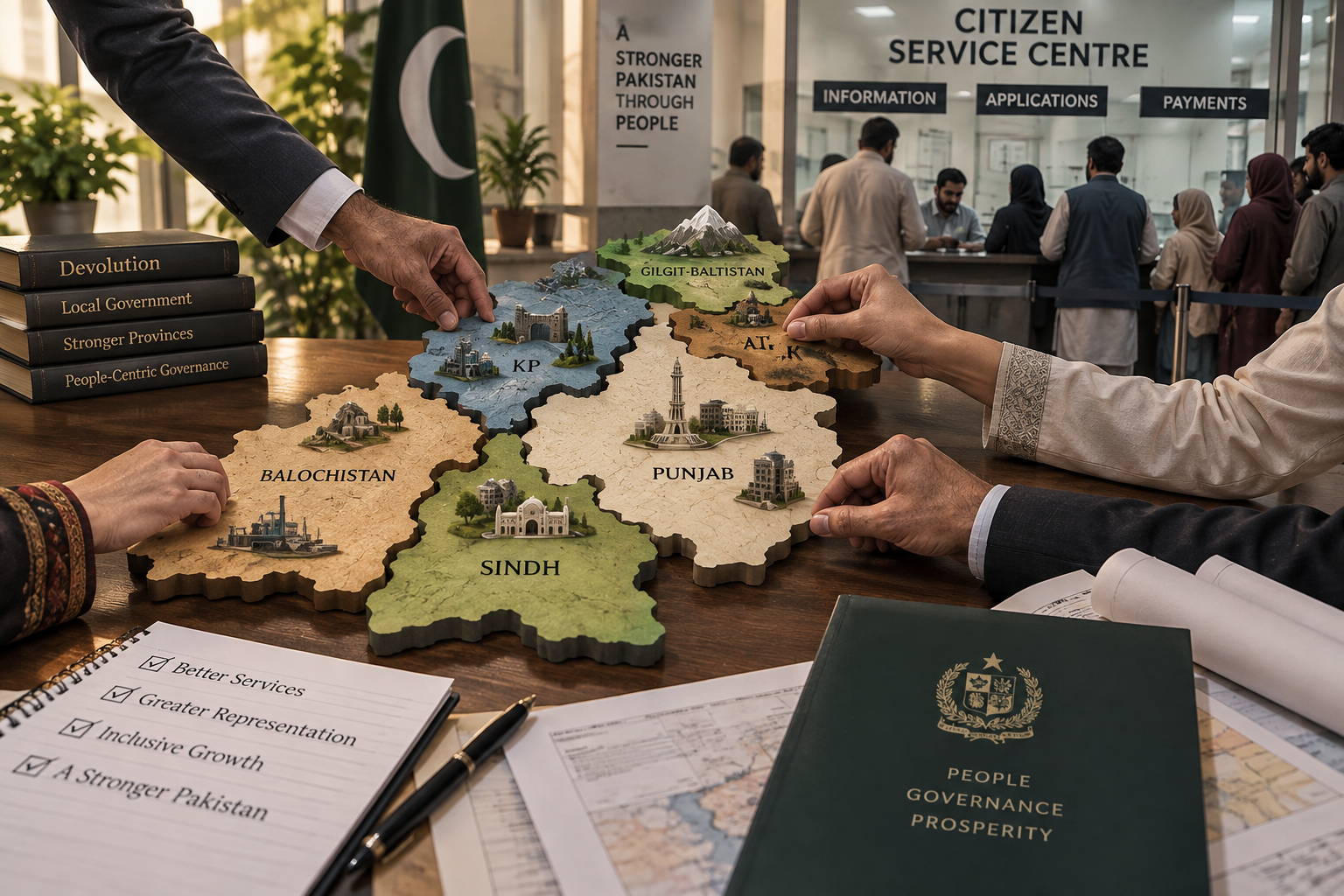
Few questions go deeper into the architecture of the Pakistani state than the renewed debate over whether the country needs more provinces, smaller administrative units, or a radically empowered local-government system. Voices of grievances that once echoed in Balochistan only have now spread across the country where people of all federating units are demanding devolution of powers and better governance and it has now entered the national policy discourse.
PTI and the PPP do not support the division of provinces or the creation of additional provinces. The PML-N, as a party, has not openly expressed its position on the matter, but its MNAs support the creation of administrative units. Khawaja Saad Rafique went so far as to say that if provinces are to be divided, it should not be limited to Punjab; administrative units should be created in every province. Meanwhile, the MQM believes that a referendum should be held to determine public opinion on the issue. Govt has decided to hold a debate on this subject during next month. Pakistan’s population, urban footprint and administrative complexity have expanded enormously, while governance structures remain heavily centralized around bureaucracy which is under resourced for the task at hand. The four provinces are geographically and demographically unequal. Punjab with a population of 127.22 M can be ranked as 9th largest country bigger than 187 countries. Sindh with a population of 55.64 M can be ranked as 27th largest country bigger than 169 countries KPK with a population of 40.64 M can be ranked as 39th largest country bigger than 157 countries Balochistan with a population of 14.56 M can be ranked as 79th largest country bigger than 117 countries. Citizens in remote districts find the provincial capital as distant and inaccessible.
The argument for smaller provinces is therefore straightforward: bring government closer to the those being governed. Supporters contend that smaller jurisdictions would mean more manageable administrations, focused development planning, better service delivery, greater political representation and more localized and hence more effective accountability. But there is an equally serious opposing argument. New provinces are not merely administrative rearrangements; they alter political power, constitutional boundaries, resource distribution and the federal balance. Sindh’s Provincial Assembly has recently rejected proposals that could alter the province’s territorial limits, while political leaders have warned that any such restructuring without broad consensus could weaken rather than strengthen the federation. Such extreme divergence of views brings the debate squarely into the realm of national security. Pakistan’s National Security Policy 2022–26 made an important conceptual departure from erstwhile narrowed military centric idea of territorial integrity to a citizen-centric Comprehensive National Security framework, declaring that the ultimate purpose of national security is the safety, security, dignity and prosperity of the people. It placed economic & human security at the core with an ultimate mission of achieving National cohesion. It means that the security of the state cannot ultimately be separated from the security and wellbeing of its citizens. Human security is not a soft or secondary concern. A citizen who lacks access to justice, education, healthcare, employment, security or dignified public services gradually develops grievances, loses confidence & stake in the state. Disinformation through digital platforms amplifies genuine grievances stemming from poor governance or lack of it and public sentiments are ultimately tapped by Sub Nationalists promoting dismemberment from the state under the garb of movements of rights; eventually what may appear to be a political problem actually becomes a national security problems.
Winston Churchill offered a useful democratic test in his 1946 speech: “Will there be fair play for the poor as well as for the rich?” He also asked whether courts would administer laws according to principles of fairness and justice, and ended with perhaps the most fundamental question: “Do the Government own the people, or do the people own the Government?” The lesson is simple. Justice, representation and responsive government create ownership; exclusion, neglect and arbitrary governance create alienation. So we should ask ourselves honestly: Does the ordinary Pakistani citizen feel that he has a meaningful stake in the state? Does he feel looked after? Does he believe that his interests are safeguarded? Or does he increasingly experience the state through poor public services, bureaucratic obstruction, unequal opportunity, political exclusion and weak accountability? If the answer is the latter, then the debate over provinces is only the visible surface of a much deeper problem. Pakistan therefore needs to look beyond the map and focus on governance. Smaller provinces may improve representation and service delivery where justified, but are no cure without responsive institutions. A strong, autonomous and well-funded local-government system at district and tehsil levels could bring government closer to citizens. Ultimately, national security begins with the citizen: as recognised by the NSP 2022–26, internal cohesion and public trust are strategic assets. Had we actualized National Security Policy of 2022 and adopted citizen-centric governance approach in 2022, movements such as BLA and PTM would have had less space to exploit grievances and turn citizen against the state. Whether through smaller provinces or empowered local governments, the imperative is the same: make government responsive to the governed.
