
Pakistan’s Dharna Culture: The Economic Cost of Long Marches and Sit-Ins
Pakistan’s political battles must increasingly be fought through institutions, ideas, ballots and dialogue — not by repeatedly bringing its capital, its citizens and its economy to a halt.

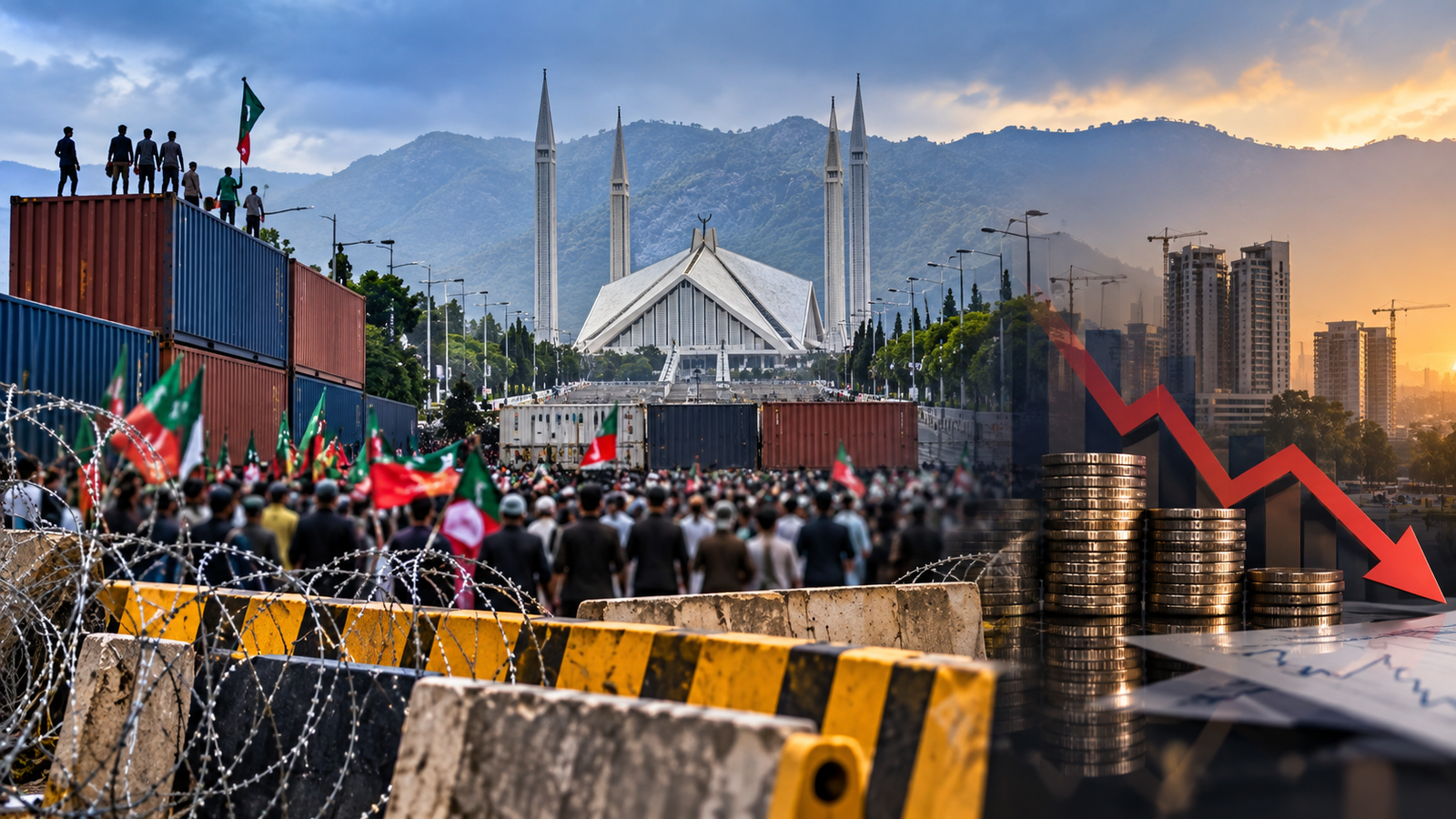
Pakistan’s recurring long marches and sit-ins disrupt Islamabad, businesses and investment. Can political dialogue finally bring an end to dharna culture?
Pakistan’s Constitution protects the right to peaceful assembly and political expression. Protest is an essential part of democracy, particularly when citizens or political parties believe their voices are not being heard through established institutions.
But over the years, Pakistan has allowed a distinction to blur: the distinction between exercising the right to protest and paralysing the state.
Long marches towards Islamabad, indefinite sit-ins, blocked highways and threats to shut down the federal capital have gradually evolved from exceptional political tactics into a recurring feature of national politics.
The consequences are no longer merely political. They are economic, administrative and increasingly damaging to Pakistan’s image as a stable country.
Successive political and religious parties have contributed to this culture. Whenever negotiations fail or political pressure needs to be intensified, Islamabad becomes the destination. Containers appear on roads, businesses brace for closures, educational institutions are affected, security forces are deployed in large numbers and citizens rearrange their lives around the possibility of confrontation.
Even before protesters arrive, the anticipation of a march can disrupt normal economic activity.
The economic cost goes far beyond the visible expense of deploying police and erecting barriers. Islamabad and Rawalpindi are important commercial and administrative centres.
When major roads are blocked, employees cannot reach workplaces, businesses lose customers, supply chains are disturbed and transportation becomes difficult. Daily-wage workers are often among the first to suffer.
Repeated instability also sends precisely the wrong signal to investors at a time when Pakistan desperately needs greater domestic and foreign investment.
There is also an opportunity cost. Thousands of police and other personnel assigned to control demonstrations are diverted from their regular responsibilities. Government offices become preoccupied with managing political crises rather than governance.
Diplomats, foreign delegations and businesses operating in the capital face uncertainty. A country trying to sell itself as a destination for investment, tourism and international cooperation cannot simultaneously allow its capital to become hostage to recurring political confrontations.
This is why the government’s emerging position that the long-march-and-sit-in trend must end deserves serious consideration — provided the state continues to protect peaceful political expression.
The objective should not be to eliminate protest. It should be to establish that no political party has an automatic right to disrupt Islamabad, block critical infrastructure or impose its political dispute on millions of citizens.
The talks between the government and opposition over the past two days therefore carry significance beyond the immediate political dispute.
If Pakistan Tehreek-e-Insaf agrees that political disagreements should be pursued through dialogue, Parliament, courts and peaceful political activity rather than repeated marches on Islamabad, it could help establish a precedent applicable to every political party — not merely PTI.
That distinction is crucial. A principle applied selectively is not a democratic principle. If Islamabad cannot be shut down by PTI, it should not be shut down tomorrow by the PML-N, PPP, a religious organisation or any other group. Governments themselves must accept the same standard when they move into opposition.
Pakistan has already seen how movements built heavily around street mobilisation can reach a dead end. Tehreek-e-Labbaik Pakistan repeatedly demonstrated its ability in previous years to mobilise supporters, stage long marches and disrupt major routes.
Yet confrontation with the state ultimately did not provide a sustainable substitute for institutional politics.
With its leadership now largely out of public political activity and the organisation’s space significantly diminished, its trajectory should offer a lesson to other political forces: street power can create immediate pressure, but it cannot replace long-term political engagement.
For PTI, which retains a substantial political constituency, the lesson should not be that dissent must disappear. Quite the opposite. A major political party has numerous avenues through which it can mobilise public opinion, challenge government policies and communicate with its supporters.
Parliament, political negotiations, public meetings at designated venues, courts, media, digital platforms and electoral politics all provide mechanisms for opposition without bringing the federal capital to a standstill.
The government, however, carries an equal responsibility. Ending “dharna culture” cannot become a convenient phrase for suppressing legitimate opposition.
Peaceful demonstrations must be facilitated at designated locations, political dialogue must remain available, and restrictions must be proportionate and applied consistently. If the government wants opposition parties to abandon disruptive street politics, it must strengthen the institutional alternatives available to them.
Pakistan has spent too many years repeating the same cycle: political confrontation, a march towards Islamabad, road closures, containers, clashes, negotiations and eventually another temporary settlement. Then, months or years later, another political force repeats the exercise.
Breaking that cycle would be a democratic achievement, not a victory for one government over one opposition party.
The message emerging from the current negotiations should therefore be larger than PTI and larger than the present government: protest remains a democratic right, but paralysing a city cannot remain a political strategy.
Pakistan’s political battles must increasingly be fought through institutions, ideas, ballots and dialogue — not by repeatedly bringing its capital, its citizens and its economy to a halt.
