
Khawaja Asif Defends Field Marshal’s Tehran Peace Mission, Hits Back at Fazlur Rehman
The exchange between the two senior politicians highlighted their disagreement over the role of civilian and military leadership in Pakistan's diplomatic engagements and broader political affairs.

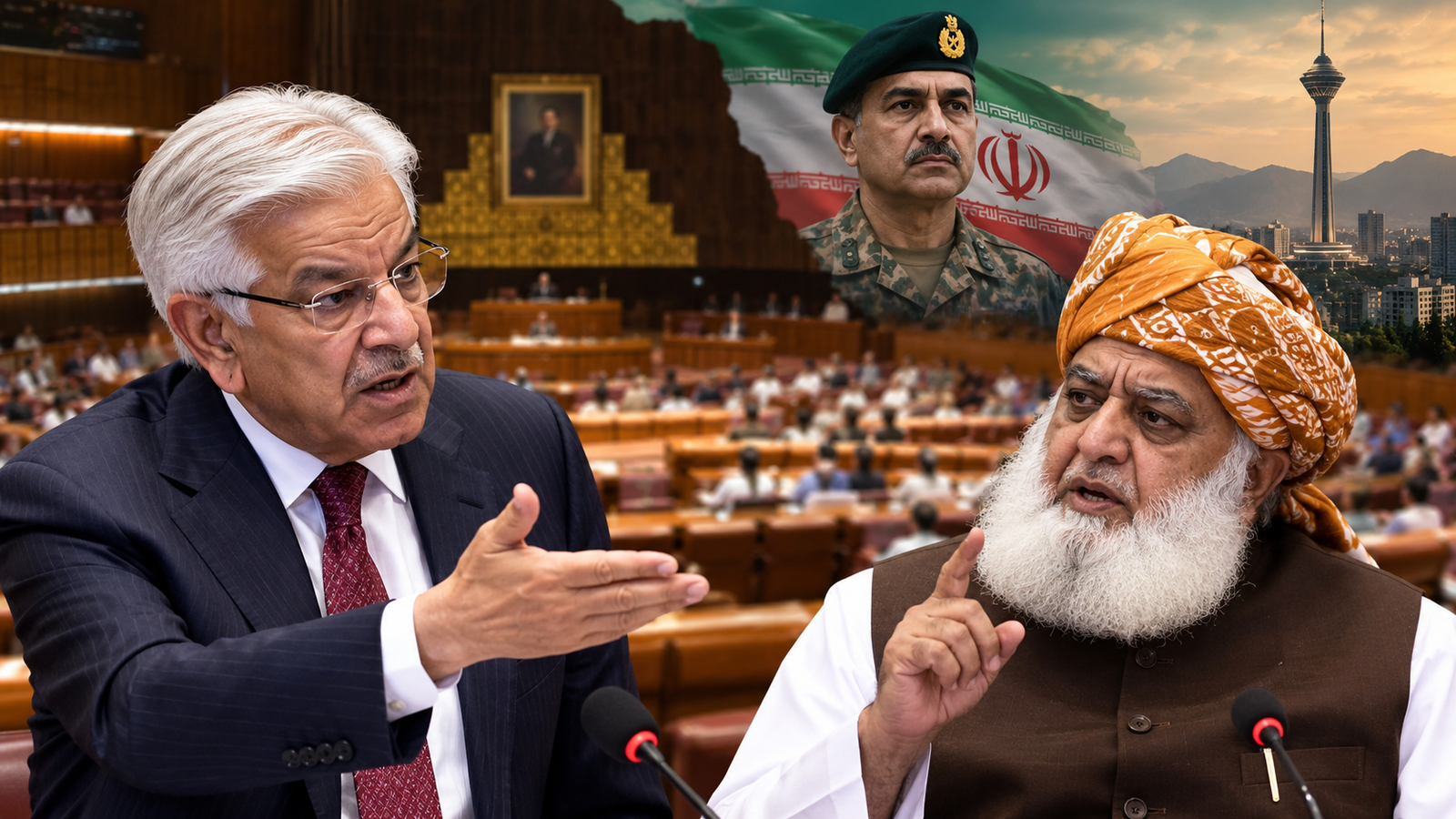
Pakistan’s Defence Minister Khawaja Asif has strongly responded to Jamiat Ulema-e-Islam-Fazl (JUI-F) chief Maulana Fazlur Rehman’s criticism of the government’s handling of a recent visit to Tehran, saying the Field Marshal travelled to Iran as a peacemaker rather than to negotiate a defence agreement.
Addressing the National Assembly on Thursday, Asif said no defence agreement was being negotiated in Tehran, nor were discussions related to Pakistan’s defence taking place. He maintained that the matters under discussion did not fall within the mandate of the Ministry of Defence and therefore did not require his presence.
The defence minister clarified that he had participated in both recent defence agreements in his official capacity.
Field Marshal Went to Tehran to Promote Peace
Defending the Field Marshal’s diplomatic role, Asif said he had travelled to Tehran with a mission to facilitate reconciliation and prevent further conflict in the Middle East.
“The Field Marshal went there to make peace. He arrived in Tehran as a messenger of peace,” Asif told the National Assembly.
He claimed the Field Marshal had helped stop a war and warned that the conflict in Yemen could otherwise have escalated.
Asif said Pakistan and the Field Marshal deserved international recognition for their diplomatic efforts, adding that the military leadership’s role was to advance peace initiatives.
He also expressed optimism that positive developments would emerge in the Middle East in the coming days.
Khawaja Asif Hits Back at Fazlur Rehman’s Criticism
The defence minister also responded sharply to personal criticism directed at him by the JUI-F chief during Wednesday’s parliamentary session.
Referring to Fazlur Rehman’s remarks about shame and decency, Asif said the JUI-F leader should also reflect on his own political record.
He questioned the positions Fazlur Rehman had held during his four decades in politics, particularly his decade-long tenure as chairman of the Parliamentary Kashmir Committee.
“What services did you perform during your ten years as chairman of the Kashmir Committee?” Asif asked.
He accused Fazlur Rehman of maintaining contradictory political positions over the years, saying no political figure could claim to be entirely beyond criticism.
Defence Minister Questions Fazlur Rehman’s Afghanistan Visit
Asif also challenged the JUI-F chief over his previous visit to Afghanistan and his willingness to engage with Afghan authorities.
He questioned whether Fazlur Rehman had been serving as foreign minister when he undertook the visit or offered to travel there.
The defence minister alleged that the purpose of the visit was to advance Fazlur Rehman’s political interests rather than fulfil an official diplomatic responsibility.
What Did Fazlur Rehman Say in the National Assembly?
The exchange followed a strongly worded speech by Maulana Fazlur Rehman in the National Assembly on Wednesday, October 28, in which he criticised the government, state institutions and Pakistan’s power structure.
Questioning the absence of senior civilian ministers from the Tehran discussions, Fazlur Rehman asked why Defence Minister Khawaja Asif and the foreign minister were sitting in Parliament while what he described as a defence-related meeting was taking place in Iran.
“There should be some shame, some decency,” he remarked.
The JUI-F chief also criticised the state’s treatment of its citizens, accusing authorities of suppressing dissent, dividing the nation and treating people as though they were a conquered population.
In a pointed reference to the military establishment, he declared:
“This country is not the personal property of any soldier or general. It belongs to all of us, to the nation and its people.”
Fazlur Rehman further warned the government against obstructing his party’s political activities, saying the JUI-F was prepared for political confrontation.
He also called for a new Charter of Democracy to address growing political instability and prevent further violence.
The exchange between the two senior politicians highlighted their disagreement over the role of civilian and military leadership in Pakistan’s diplomatic engagements and broader political affairs.