
Over 560 French High Schools Hit as Student Protest Movement Intensifies
The protests in France come amid a broader pattern of youth-led movements in which younger generations are using street demonstrations

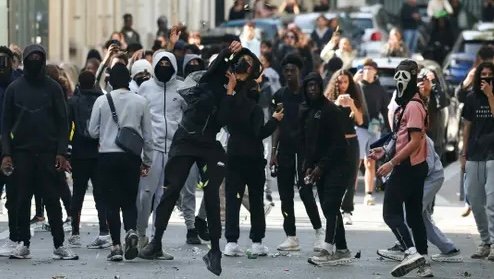
A growing student protest movement demanding better educational conditions has spread across France, disrupting more than 560 high schools as students block campuses and clash with police, according to an international news agency.
The movement began last week in the Paris region before rapidly spreading across the country, with teenage students in their final years of schooling blocking access to schools and staging demonstrations over long school hours, inadequate facilities and frequent staff absences.
On Friday, students lit fires outside some schools and faced off with police, while authorities used tear gas at several locations to disperse protesters.
“For a whole year, we didn’t have a science teacher. We don’t have any textbooks,” 15-year-old Simon told the international news agency outside Turgot high school in central Paris.
“And still, we’re the lucky ones. It’s even worse in the suburbs,” he added.
The French government has acknowledged that students have legitimate grievances but condemned what it described as “urban violence.” Students, meanwhile, have accused police of using excessive force, including regularly firing tear gas canisters during demonstrations.
Schools Damaged as Protests Intensify
In Paris on Friday, fires damaged the entrances of Leonard de Vinci high school in the south of the capital and Gaston-Bachelard high school in the southeast, with firefighters called to extinguish the blazes, according to the international news agency.
Education Minister Edouard Geffray said the student movement was being “held hostage by ultra-violent fringe groups.”
France’s Education Ministry said shortly after midday that education had been disrupted at more than 560 of the country’s approximately 3,700 high schools. The Interior Ministry said more than 1,000 high schools had been affected on Thursday.
Several schools have also planned to conduct classes remotely, particularly in the southern city of Marseille.
According to Geffray, at least 65 staff members, including 40 high school principals, have been injured since the protests began. Around 170 students have also been wounded, while more than 100 high schools have suffered what he described as “severe damage.”
“What matters now is ensuring our children are no longer out on the streets, because they are in danger,” Geffray told BFMTV, urging parents to discourage their children from joining the demonstrations.
Around 2,000 Taken Into Police Custody
Justice Minister Gerald Darmanin said he had asked prosecutors to hold parents liable for damage caused by their children during the protests and require them to pay for repairs.
Around 2,000 people have been taken into police custody since the movement began, with minors accounting for 90 percent of them, Darmanin told RTL.
Tensions were also reported in Rennes, where students dressed in black and wearing balaclavas gathered near the Jean-Mace high school amid a heavy police presence.
“As far as we’re concerned, we’ve won — our school is closed this morning,” 16-year-old Lola told the international news agency.
She also criticised the police response, saying the use of force and tear gas was making students “even angrier.”
Police also used tear gas at the Kerichen high school in Brest in western France, according to the international news agency.
Student Movement Enters Political Debate
The demonstrations have also entered France’s political debate ahead of the presidential election, with the government accusing the hard-left France Unbowed (LFI), whose leader Jean-Luc Melenchon is again running for the presidency, of being behind the movement.
Senior LFI official Manuel Bompard rejected the allegation, accusing the government of “descending into conspiracy theories.”
The protests in France come amid a broader pattern of youth-led movements in which younger generations are using street demonstrations and digital mobilisation to demand changes in education and public policy. Similar Gen Z-led demonstrations over education-related grievances have also emerged elsewhere, underscoring the growing willingness of young people to directly challenge governments over issues affecting their future.