
Moscow Format’s Changing Tone: Russia Moves Closer to Taliban
The shift was particularly visible at the eighth edition of the Moscow Format regional consultations on Afghanistan, which concluded without a joint statement.

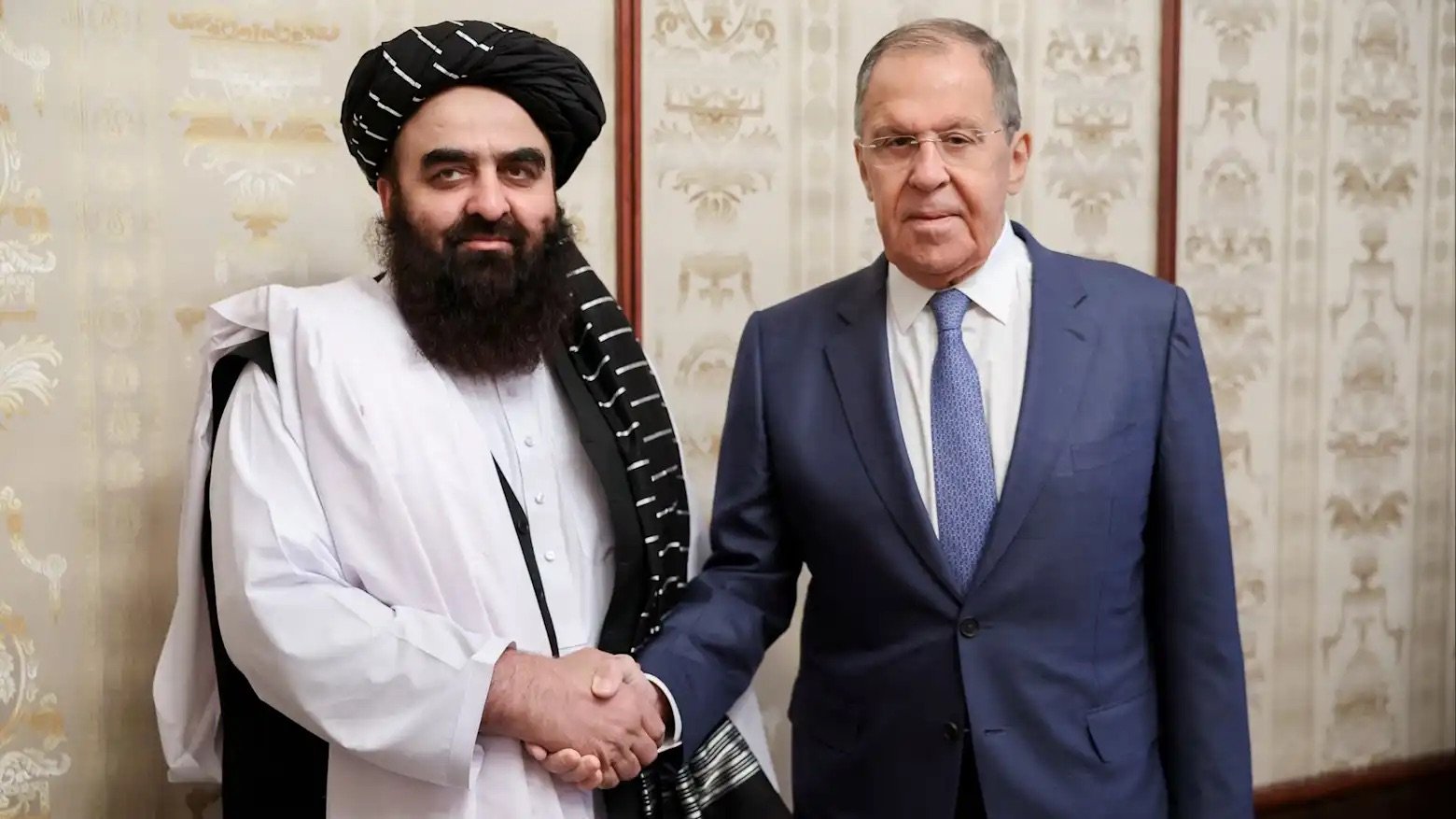
Russia’s approach towards the Afghan Taliban at the Moscow Format has undergone a striking transformation over the years, moving from emphasis on UN resolutions and pressure on the Taliban to fulfil international obligations to formal recognition and, now, praise of the Taliban government’s performance against terrorism.
The shift was particularly visible at the eighth edition of the Moscow Format regional consultations on Afghanistan, which concluded without a joint statement.
Russian Foreign Minister Sergey Lavrov said the Taliban government had performed “relatively successfully” over the past five years and had dealt significant blows to Islamic State Khorasan Province (ISIS-K) and other terrorist groups.
He emphasised that strengthening Afghanistan’s counterterrorism capacity serves broader regional interests and affirmed that Russia would continue assisting the Taliban through military-technical cooperation between Moscow and Kabul.
The commitment adds another dimension to Moscow’s changing relationship with the Taliban, with engagement now extending beyond diplomatic recognition to cooperation in the military-security sphere.
The language stands in contrast to Moscow Format discussions in previous years
In 2021, participants recalled the importance of relevant UN resolutions on Afghanistan. By 2023, when the Taliban participated in the fifth Moscow Format Consultation in Kazan, the platform remained an important mechanism for dialogue, with pressure on the Taliban to fulfil its international obligations forming part of the broader diplomatic discourse.
Security concerns remained prominent in 2025, when participants underscored that terrorism constituted a serious threat to Afghanistan, the region and the wider world. They also declared the presence of foreign military forces in Afghanistan or neighbouring countries “unacceptable.”
Lavrov maintained that position at the latest meeting, saying foreign military deployment in Afghanistan would be unacceptable under any pretext and arguing that historical experience showed such a presence leads to instability and increased conflict.
What has changed considerably is Moscow’s assessment of the Taliban government itself
Senior international affairs analyst Kamran Yousaf said Lavrov’s latest address effectively gave the Afghan Taliban a “clean chit.”
“Russian FM Sergey Lavrov’s speech at the Moscow meeting has given a clean chit to Afghan Taliban. Lavrov portrays Taliban regime as ‘national govt’, praises its efforts against terrorism and lauded its achievements,” Yousaf said.
The biggest story coming out of Moscow is not Pakistan-Taliban trading blame but Russia’s open support for the Afghan Taliban.
Russian FM Sergai Lavrov speech at the Moscow meeting has given a clean chit to Afghan Taliban. Lavrov portays Taliban regime as “national govt”, praises its efforts against terrorism and lauded its achievements.
This is totally the opposite of Pakistan’s position.
It is evident that Russia is certaintly upset with Pakistan. Moscow is not supporting Taliban out of any affection or love but it seems a bigger strategic game is at play.
Russia and Pakistan have achieved rapproachment after years of hardwork but that seems to be on the line now!
— Kamran Yousaf (@Kamran_Yousaf) October 5, 2026
Lavrov’s assessment also comes against continuing international concerns over terrorist organisations operating from Afghanistan. UN assessments have documented the presence of terrorist groups in the country, while the UK Special Envoy for Afghanistan has also acknowledged their continued presence.
Why Moscow’s View of the Taliban Has Changed
Political analyst Dr Andrew Korybko, responding to a question from PPC Digital, said Russia’s current approach is largely driven by the threat it perceives from ISIS-K.
“Russia sees the Taliban as a bulwark against ISIS-K, which participated in spring 2024’s infamous terrorist attack against the Crocus mall in Moscow,” Korybko told PPC Digital.
He said Moscow has previously acknowledged that other terrorist groups operate on Afghan soil but does not believe the Taliban is allied with them.
“From Russia’s perspective, the Taliban is its and its CSTO Central Asian allies’ anti-terrorist vanguard against ISIS-K, which they consider to be their top terrorist threat,” Korybko said.
“Therefore, Russia conceptualizes its regional interests as being best advanced by partnering with the Taliban, including in the military-security domain.”
His assessment also puts Lavrov’s commitment to continued military-technical cooperation with Kabul into a broader strategic context, suggesting that Moscow increasingly sees strengthening the Taliban’s security capabilities as serving its own security interests and those of its Central Asian allies.
The Crocus City Hall attack in Moscow in March 2024 reinforced Russian concerns over ISIS-K and demonstrated the threat the group could pose beyond Afghanistan.
Moscow’s changing policy became formal in 2025. Russia’s Supreme Court removed the Taliban from its official list of terrorist and outlawed organisations in April, and on July 3, 2025, Russia became the first country to formally recognise the Taliban-led government after the group returned to power in August 2021.
From Soviet War to Engagement With Kabul
Russia’s current relationship with Afghanistan carries the weight of a turbulent history.
The Soviet Union sent troops into Afghanistan in December 1979, beginning a nearly decade-long war against Afghan resistance forces. Pakistan became a major frontline state during the conflict, supporting the Afghan resistance alongside the United States and other countries.
Soviet forces withdrew in February 1989, leaving behind a conflict that had inflicted enormous human and economic costs and reshaped regional geopolitics.
Decades later, Moscow returned to Afghan affairs through regional diplomacy rather than direct military intervention.
The Moscow Format Consultations on Afghanistan, launched in 2017, developed into a regional platform involving Russia, Afghanistan, India, Iran, China and Pakistan, alongside Central Asian states.
The process initially sought to facilitate political reconciliation between the then internationally backed Kabul government and the Taliban, establish peace and address regional security threats.
Moscow’s interests centred particularly on preventing instability and extremism from spreading from Afghanistan into Central Asia, countering narcotics trafficking towards Russia and opposing a renewed US or Western military presence in Afghanistan and Central Asia.
The Taliban eventually joined the fifth Moscow Format Consultation in Kazan on September 29, 2023.
Pakistan-Russia Relations Move Beyond Cold War Legacy
The evolution of Moscow’s Afghanistan policy has also taken place alongside improving Pakistan-Russia relations.
Pakistan and the Soviet Union stood on opposing sides during much of the Cold War, particularly during the Soviet-Afghan war. Relations gradually began moving beyond that legacy, with a more visible improvement in bilateral engagement since around 2019.
Islamabad and Moscow have since expanded cooperation and dialogue in diplomacy, security, counterterrorism, trade, energy and regional affairs.
Afghanistan has emerged as an important area of interaction, with both countries participating in regional mechanisms focused on stability and preventing terrorism from spilling across borders.
From Pressure to Recognition
The evolution of the Moscow Format provides a clear window into Moscow’s changing approach. Moscow’s changing policy became formal in 2025. Russia’s Supreme Court removed the Taliban from its official list of terrorist and outlawed organisations in April, and on July 3, 2025, Russia became the first country to formally recognise the Taliban-led government after the group returned to power in August 2021.
At the latest Moscow Format, Lavrov went further by describing the Taliban administration’s performance as relatively successful, highlighting its counterterrorism achievements and committing Moscow to continued military-technical cooperation with Kabul.
Korybko’s assessment explains Moscow’s security calculation: Russia increasingly sees the Taliban as a barrier against ISIS-K and therefore considers cooperation with Kabul beneficial to Russian and Central Asian security.
Yousaf, however, views Lavrov’s remarks differently — as effectively giving the Taliban a “clean chit” despite continuing international concerns over terrorist groups operating from Afghanistan.
The change in Moscow’s language and policy over the years is therefore significant: from pressure over international obligations to recognition, military-technical cooperation and an increasingly security-driven partnership with the Taliban.
