
America Revisits Its Afghan War, Pakistan’s Experience Takes Centre Stage
Field Marshal Munir shared Pakistan’s perspective on the security dynamics that shaped the conflict and highlighted the challenges faced by the country during the prolonged war in neighbouring Afghanistan.

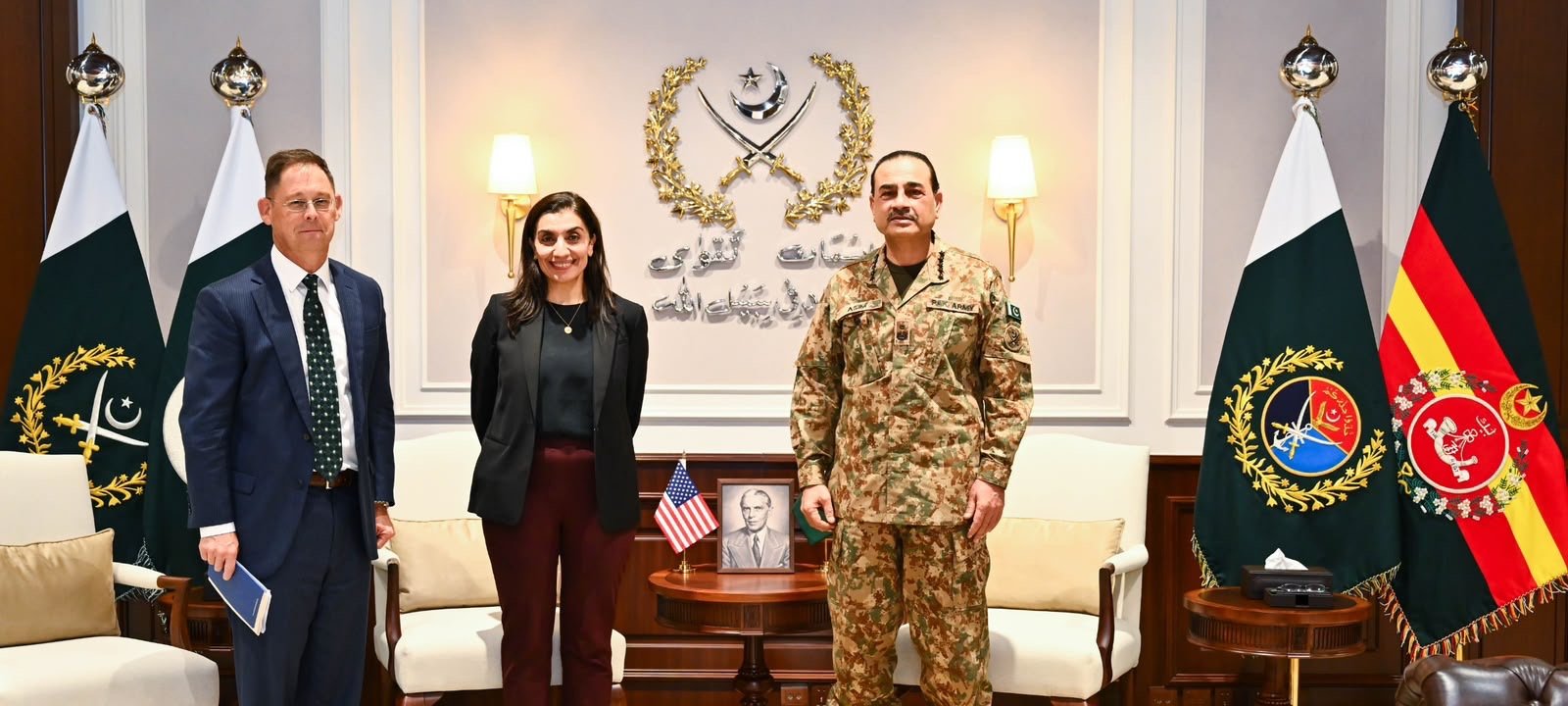
A delegation of the US Afghanistan War Commission met Field Marshal Syed Asim Munir, Chief of Army Staff (COAS) and Chief of Defence Forces (CDF), at General Headquarters (GHQ) in Rawalpindi on Monday, as the congressionally established body continues its review of America’s 20-year engagement in Afghanistan.
The meeting comes amid heightened tensions between Pakistan and Afghanistan over cross-border security and terrorism, adding significance to the Commission’s consultations with Islamabad as it gathers regional perspectives for its final assessment of the US war in Afghanistan.
According to the Inter-Services Public Relations (ISPR), the delegation was led by the Commission’s co-chairs, Shamila N. Chaudhary and Dr Colin F. Jackson.
Discussions covered matters of mutual interest, including Pakistan’s support during the Afghanistan conflict, the regional security environment and developments in Afghanistan, with a particular focus on perspectives relevant to the Commission’s work.
Field Marshal Munir shared Pakistan’s perspective on the security dynamics that shaped the conflict and highlighted the challenges faced by the country during the prolonged war in neighbouring Afghanistan.
He underscored the importance of incorporating regional perspectives and Pakistan’s experience while assessing the strategic, diplomatic and operational dimensions of the conflict.
The US delegation acknowledged Pakistan’s longstanding role and sacrifices during the conflict in Afghanistan and appreciated its continued contribution to regional peace and stability, according to ISPR.
Meeting comes amid heightened Pakistan-Afghanistan tensions
The Commission’s engagement with Pakistan comes at a sensitive point in Islamabad-Kabul relations, with Pakistan maintaining that terrorist groups operating from Afghan territory pose a direct threat to its security.
Tensions have intensified in recent days following drone incursions into Pakistani airspace and subsequent Pakistani strikes against locations inside Afghanistan that Islamabad said were being used for launching and storing drones.
Pakistan has repeatedly called on the Afghan Taliban authorities to prevent Afghan territory from being used by terrorist groups against Pakistan, while Kabul has rejected various Pakistani allegations concerning security incidents and militant activity inside Afghanistan.
Against this backdrop, the Commission’s meeting with Pakistan’s military leadership gives Islamabad an opportunity to present its assessment of the long-term security consequences of the Afghan conflict, cross-border terrorism and the evolving regional security environment to a bipartisan body established by the US Congress.
The timing is particularly relevant because the Commission is now working towards its final assessment of the US experience in Afghanistan, including the strategic and security consequences of decisions taken during the two-decade conflict.
ISPR, however, did not describe Monday’s meeting as an attempt to mediate the current Pakistan-Afghanistan tensions. The discussions were presented as part of the Commission’s broader review of America’s engagement in Afghanistan and its consultations on regional perspectives.
Why Pakistan’s perspective matters to the Commission
Pakistan was a major regional actor throughout the US-led war in Afghanistan between 2001 and 2021.
The country cooperated with Washington on counterterrorism and faced security and economic consequences from instability and violence associated with the conflict.
US-Pakistan relations during the war also went through periods of significant disagreement, particularly over counterterrorism strategy, cross-border security and the Afghan Taliban.
Pakistan was subsequently involved in diplomatic efforts related to Afghanistan, including engagement surrounding negotiations between the United States and the Taliban before the withdrawal of US forces in August 2021.
The Commission’s engagement with Pakistan therefore provides it with a regional perspective as it examines the decisions, policies and assumptions that shaped America’s longest war and their consequences.
What is the Afghanistan War Commission?
The Afghanistan War Commission is a bipartisan legislative commission established by the US Congress in December 2021 to conduct a comprehensive review of key decisions related to US military, intelligence, foreign assistance and diplomatic involvement in Afghanistan from June 2001 to August 2021, according to the information available on AWC website.
The 16-member Commission was constituted to examine the United States’ 20-year involvement in Afghanistan and identify lessons from the conflict.
Its work includes examining what the Afghanistan war can teach the United States about the promise and limitations of building partner military forces through security force assistance.
The Commission issued an interim report in 2024 and had been expected to complete its final assessment in 2026.
Its mandate was subsequently extended by another year, giving the Commission additional time to complete its final report, which is now due in August 2027.
Announcing the extension in August 2026, co-chairs Chaudhary and Jackson said: “We welcome extension of the Afghanistan War Commission’s mandate for one year, providing the additional time necessary to complete a comprehensive, independent, and rigorous assessment of America’s 20-year war in Afghanistan. Our final report is now due in August of 2027.”
The final report is expected to examine the strategic, diplomatic and operational decisions that shaped the US involvement in Afghanistan and draw lessons that could inform future US military engagements, diplomacy and security force assistance.
