
Islamabad High Court Orders Strict Enforcement of Laws Against Online Harassment and Blackmail
According to the PTA report, the compliance rate for blocking content related to Pakistan's defence and national security stood at 59.1%

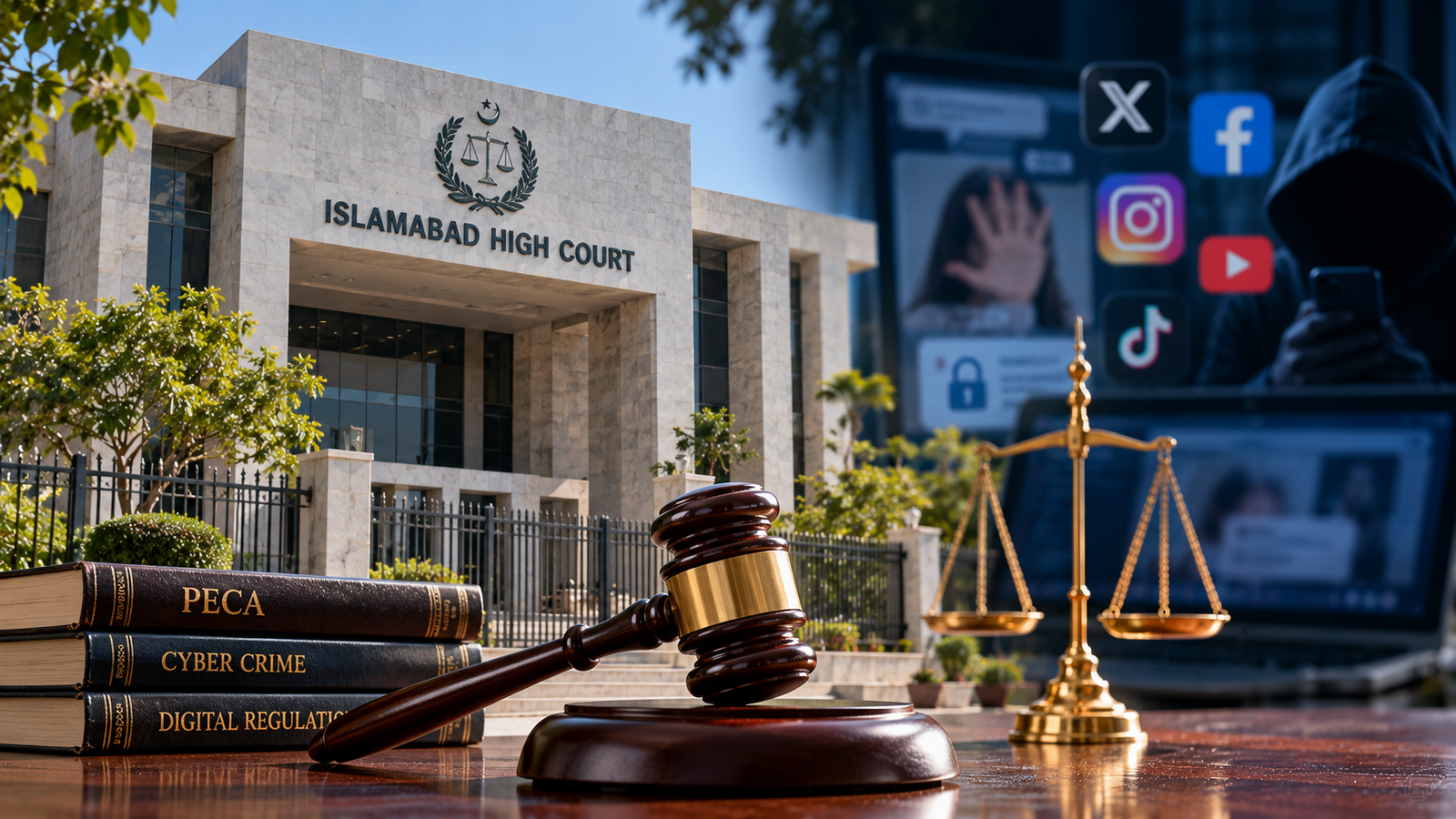
The Islamabad High Court (IHC) has ordered the implementation of existing laws to prevent online harassment, blackmail and the unauthorised circulation of private content, directing the Pakistan Telecommunication Authority (PTA), Pakistan Electronic Media Regulatory Authority (PEMRA) and National Cyber Crime Investigation Agency (NCCIA) to submit comprehensive reports.
Justice Arbab Muhammad Tahir issued a written order directing the Ministry of Information Technology, PEMRA, PTA, NCCIA and other relevant ministries and departments to convene a meeting to review the enforcement of laws governing digital media and online misconduct.
The court instructed the concerned institutions to identify legal, administrative and technical obstacles hindering the implementation of existing laws and explain what measures have been taken or proposed to address these challenges.
The written order also directed the authorities to identify areas requiring greater coordination between institutions and outline mechanisms for improving cooperation in handling complaints related to online harassment, blackmail and the unauthorised sharing of private material.
The court sought details of measures taken by relevant institutions to prevent such violations and ensure the effective implementation of legal protections.
The IHC also incorporated a written report submitted by the PTA into its order, providing details of compliance rates for requests to block unlawful content on social media platforms.
According to the PTA report, the compliance rate for blocking content related to Pakistan’s defence and national security stood at 59.1%, while requests involving terrorism-related content recorded a compliance rate of 79.51%.
The report revealed that 76.54% of requests involving content against the sanctity of Islam were complied with, while the compliance rate for content related to decency and morality reached 98.91%. Requests concerning sectarian and hate-related content recorded a compliance rate of 64.43%.
Platform-specific figures showed that X, formerly Twitter, recorded a content-blocking compliance rate of 48.42%, compared with 78.57% for Facebook and 79.52% for Instagram.
YouTube recorded a compliance rate of 87.34%, while TikTok registered 88.68%, according to the PTA report.
The written order further noted that social media companies had been asked to fulfil registration requirements with the PTA and appoint local officers to address complaints. However, no positive response had been received.
According to the PTA, social media operators frequently reject requests to remove unlawful content.
The court also referred to provisions of the Prevention of Electronic Crimes Act (PECA), which envisage the establishment of a Social Media Protection and Regulatory Authority with extensive powers and responsibilities to remove or block unlawful online content.
Justice Arbab Muhammad Tahir questioned whether the competent authorities were effectively exercising the legal powers available to them under existing laws and regulations.
The court emphasised the need to examine the extent of coordination between PEMRA, PTA and NCCIA to determine whether existing mechanisms are sufficient to address complaints involving digital media platforms.
The relevant institutions have been directed to submit comprehensive reports on enforcement measures, implementation challenges and coordination mechanisms to strengthen protections against online harassment, blackmail and the misuse of private content.