
Why AI Is Moving From the Cloud to Your Device
For users, the biggest change may be that the computer or smartphone in front of them becomes more than a gateway to an AI service running somewhere else.

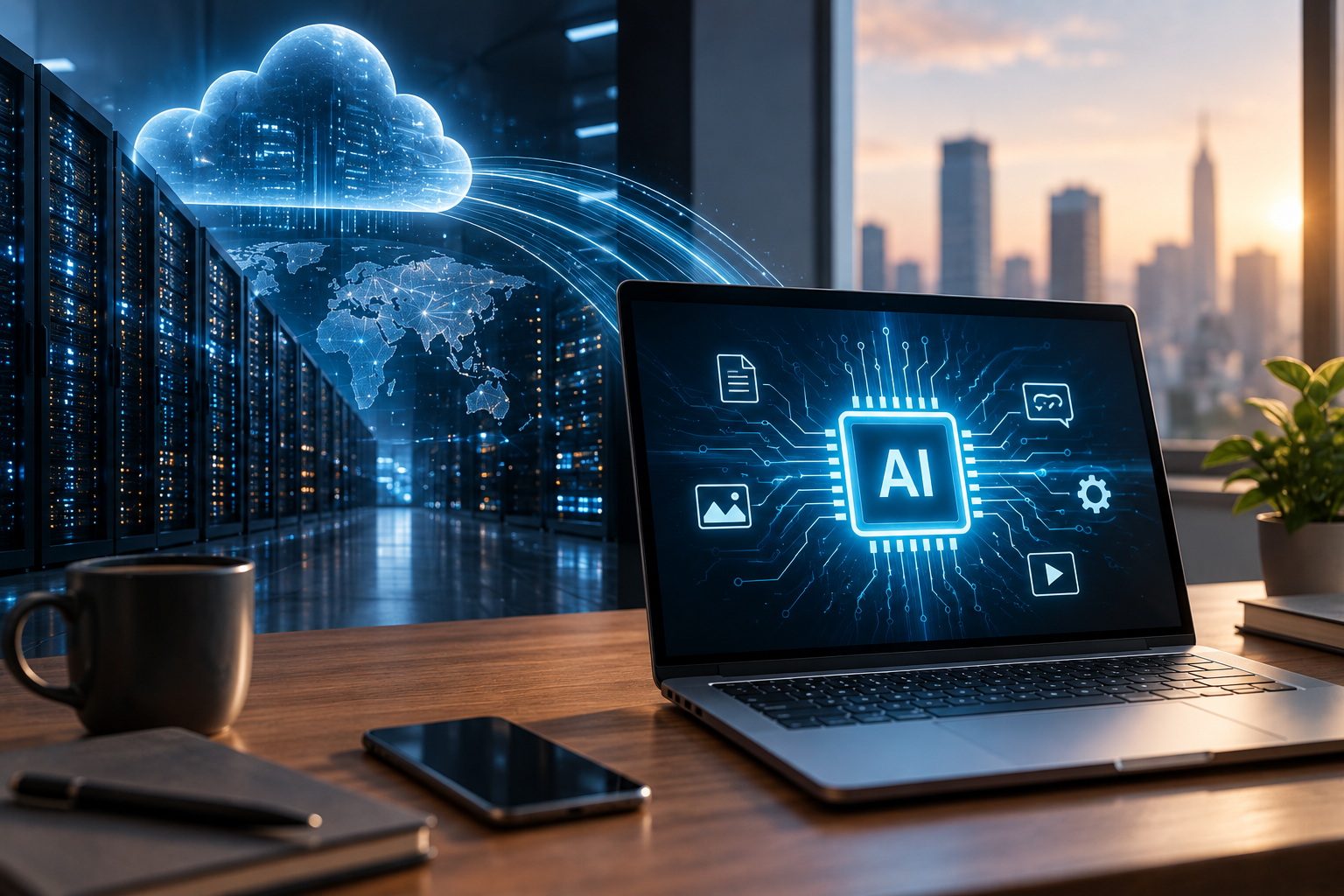
Artificial intelligence has largely been powered by massive cloud data centres, where users’ requests are sent to remote servers for processing before results are returned to their devices.
But the technology industry is increasingly moving toward another model: on-device or local AI, where more artificial intelligence workloads can be processed directly on smartphones, laptops and personal computers.
The development does not mean cloud-based AI is disappearing. Instead, the industry is moving toward a hybrid AI ecosystem, combining the computing power of the cloud with increasingly capable processors inside consumer devices.
What Is Local AI?
Local AI refers to artificial intelligence models and applications that run partly or entirely on a user’s own device rather than relying exclusively on remote data centres.
Advances in graphics processing units (GPUs), neural processing units (NPUs) and more efficient AI models are making it possible for computers and smartphones to perform increasingly sophisticated AI tasks locally.
Depending on the hardware and software, these can include text generation, transcription, image processing, translation, document analysis and coding assistance.
Some applications can operate entirely offline, while others use a combination of local processing and cloud services.
Big Tech Pushes More AI Onto Devices
Major technology companies are investing heavily in hardware and software designed to handle AI workloads directly on consumer devices.
NVIDIA has increasingly positioned its RTX-powered computers as platforms capable of running generative AI models locally, allowing developers and users to perform some AI workloads without depending entirely on cloud-based services.
Microsoft has also placed on-device AI at the centre of its Copilot+ PC strategy, with newer computers incorporating dedicated NPUs designed to process certain AI functions locally.
Apple, meanwhile, uses on-device processing for a range of Apple Intelligence features. More computationally demanding requests can use its Private Cloud Compute infrastructure, illustrating how local and cloud AI can work together rather than one completely replacing the other.
Why Local AI Matters for Privacy
Privacy is one of the strongest arguments for on-device AI.
When a task is processed entirely locally, information does not need to be transmitted to a remote AI server for that particular computation. This can be particularly useful when working with confidential documents, private photographs, business information or sensitive data.
Local processing, however, does not eliminate privacy or cybersecurity risks. The level of protection still depends on the operating system, application permissions, security of the device and how individual AI applications are designed.
Faster Responses and Offline AI
Running an AI model locally can also reduce dependence on internet connectivity and eliminate the network round-trip required when a request must travel to a remote data centre.
That could make some AI features faster and allow them to function in places where internet access is limited or unavailable.
For users in countries or regions with unreliable or expensive connectivity, increasingly capable offline AI could have particular significance.
Could Local AI Reduce Dependence on Data Centres?
The rapid expansion of generative AI has increased demand for data-centre computing capacity and electricity.
Moving some AI inference—the process of using a trained model to generate an answer or perform a task—to consumer devices could reduce the need to send every AI request to a centralised server.
However, local AI does not eliminate energy consumption. It effectively shifts some computational demand from data centres to users’ own devices, while the training of the largest AI models is still expected to require substantial data-centre infrastructure.
What It Means for Everyday Users
For consumers, the expansion of local AI could eventually mean more applications capable of working offline, faster responses for certain tasks and greater control over where personal information is processed.
It could also reduce reliance on paid cloud APIs for some developers and advanced users who have hardware powerful enough to run models locally.
Another potential advantage is personalisation. With appropriate permissions, locally running AI applications could work with information stored on a user’s device without necessarily uploading that information to an external AI service.
But the capabilities will vary considerably depending on the model, hardware and application being used.
Cloud AI Is Not Going Away
The rise of local AI should not be viewed as the end of cloud computing.
The world’s largest and most capable AI models still require enormous computing resources, and cloud infrastructure remains essential for training models and handling demanding workloads that consumer devices cannot efficiently process.
Instead, the next phase of artificial intelligence is increasingly likely to be hybrid: smaller and specialised models running locally for speed, privacy and offline functionality, while larger workloads continue to be handled in the cloud.
For users, the biggest change may be that the computer or smartphone in front of them becomes more than a gateway to an AI service running somewhere else. Increasingly, the device itself will be capable of running the intelligence.
