
Security Crisis Fuels Political Showdown Over Emergency in KP
The debate gained momentum following a meeting between leaders of the Pakistan Muslim League-Nawaz (PML-N) and Pakistan Peoples Party (PPP) in the Speaker’s Chamber.

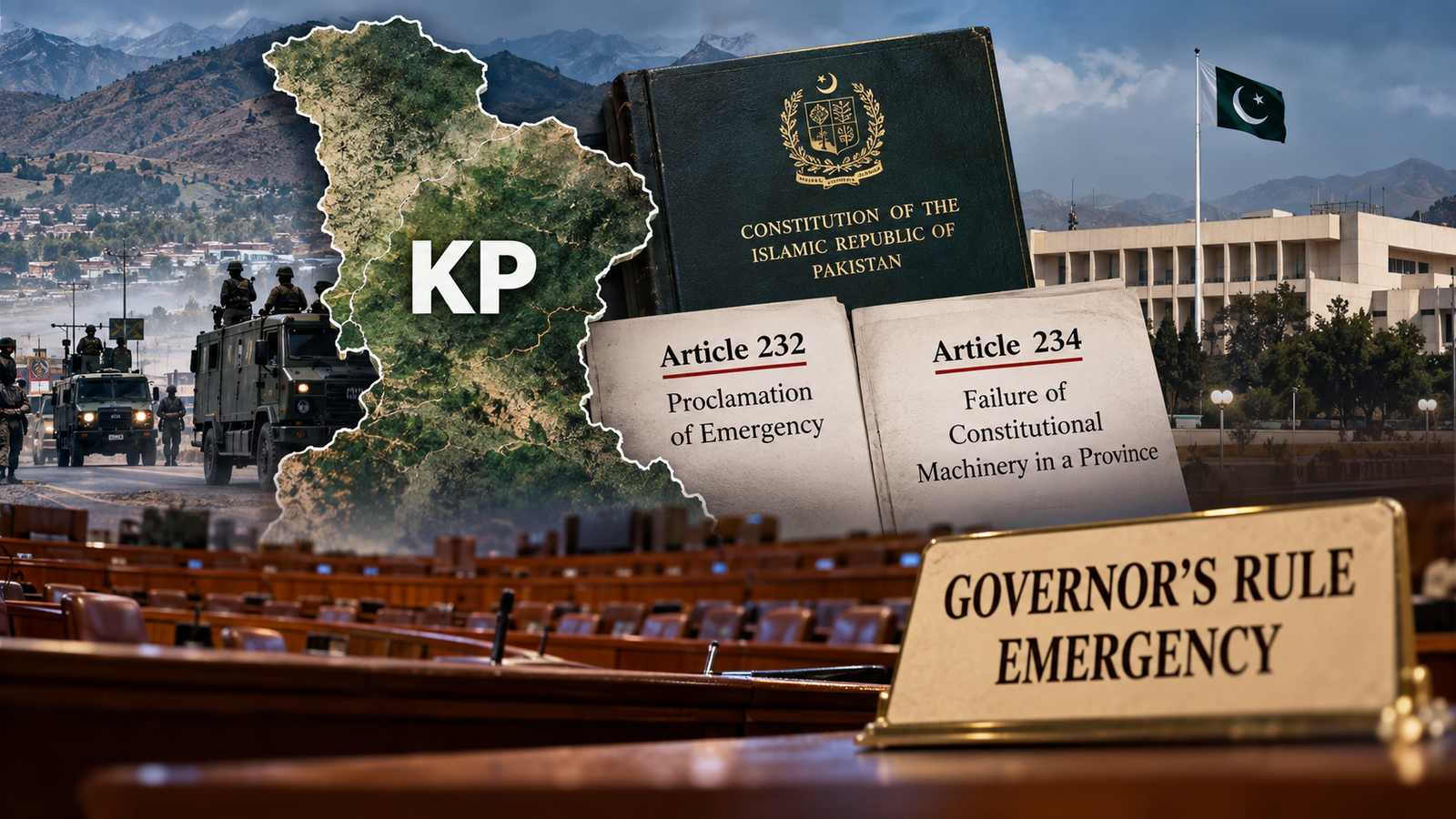
Political tensions surrounding Khyber Pakhtunkhwa have intensified as federal ministers publicly discuss the possibility of imposing an emergency or Governor’s Rule in the province, citing the deteriorating security situation, while PTI and ANP leaders oppose such measures.
The debate gained momentum following a meeting between leaders of the Pakistan Muslim League-Nawaz (PML-N) and Pakistan Peoples Party (PPP) in the Speaker’s Chamber.
Speaking to the media after the meeting, Federal Law Minister Azam Nazeer Tarar said the government takes the PPP into confidence on such meetings and matters.
“Governor’s Rule is a constitutional procedure. If circumstances are moving in that direction, it can happen,” Tarar said, adding that a decision would be taken by the constitutional authorities mentioned in the Constitution.
Referring to the security situation in Khyber Pakhtunkhwa, Tarar pointed to the continuing loss of lives in the province, saying, “The daily martyrdoms taking place in Khyber Pakhtunkhwa — these are those circumstances.”
Govt seriously considering emergency under Article 232
Federal Minister for Parliamentary Affairs Tariq Fazal Chaudhry said the federal government was seriously considering imposing an emergency in Khyber Pakhtunkhwa under Article 232 of the Constitution, citing what he described as the provincial government’s failure to deal with terrorism.
He said terrorism was increasing rapidly in KP, with civilians and personnel responsible for maintaining law and order losing their lives.
Chaudhry said the KP government had failed to bring the law-and-order situation under control. He also said the PPP would cooperate with the government if an emergency was imposed, adding that the government was prepared to bear whatever political cost such a decision might entail.
KP Governor says no letter sent to President
Khyber Pakhtunkhwa Governor Faisal Karim Kundi, a PPP leader, meanwhile, said he had not yet written to President Asif Ali Zardari regarding the deteriorating situation in the province.
Kundi said any decision on whether and when an emergency or Governor’s Rule should be imposed in Khyber Pakhtunkhwa would be taken by the President and the Prime Minister.
His remarks came as discussions over extraordinary constitutional measures gained momentum amid the worsening security situation and growing political confrontation between the federal and provincial governments.
Imran Khan’s release is a matter for courts: Tarar
Responding to the opposition’s demands regarding PTI founder Imran Khan, Tarar said his appeal was still pending before the court and the government could not decide his release.
“It is a matter for the court. The government does not have to decide his release; it falls within the jurisdiction of the court,” the law minister said.
Tarar added that if the basis of a protest itself was unconstitutional, the opposition would have to reconsider its demand.
PTI rejects emergency, long march decision ‘final’
PTI leader and former National Assembly speaker Asad Qaiser, speaking to the media in Charsadda, said the provincial government’s authority had already effectively been taken away.
“Impose Governor’s Rule; there is no problem. The police in the province are helpless and orders are coming from somewhere else,” Qaiser said, claiming that Khyber Pakhtunkhwa was already effectively under Governor’s Rule.
PTI Chairman Barrister Gohar Ali Khan, however, said there should be no emergency in Khyber Pakhtunkhwa and maintained that no situation existed in the province that warranted such a step.
Gohar said PTI’s decision to hold a long march was political and final, adding that the march would remain peaceful and was not intended as an assault on anyone.
ANP calls emergency, Governor’s Rule ‘undemocratic’
Awami National Party (ANP) central president Aimal Wali Khan also opposed the possibility of extraordinary constitutional measures in the province.
He said imposing either Governor’s Rule or an emergency in Khyber Pakhtunkhwa would be an undemocratic step, arguing that the fundamental, constitutional and democratic rights of the people could not be taken away in the name of an emergency.
What is Governor’s Rule?
In Pakistan, the term “Governor’s Rule” generally refers to the mechanism provided under Article 234 of the Constitution, which deals with a failure of constitutional machinery in a province. If the President is satisfied, on receiving a report from the governor or otherwise, that the government of a province cannot be carried on in accordance with the Constitution, a proclamation can be issued under the constitutional procedure. Such a proclamation can involve the assumption of specified provincial executive functions and arrangements for Parliament to exercise the powers of the provincial legislature. The measure is subject to constitutional safeguards and parliamentary approval.
What does Article 232 say?
Article 232 of the Constitution deals with a proclamation of emergency. It provides a constitutional mechanism where the security of Pakistan, or any part of the country, is threatened by war, external aggression or internal disturbance beyond the power of a provincial government to control. An emergency under Article 232 is constitutionally distinct from the mechanism commonly described as Governor’s Rule under Article 234, although both have entered the current political debate surrounding KP.
Why is KP situation turning into political turmoil?
The situation in Khyber Pakhtunkhwa is increasingly developing into a political as well as security confrontation. The federal government is citing rising terrorism, continuing casualties and what its ministers describe as the provincial government’s inability to control the security situation while openly discussing constitutional options.
At the same time, the PTI-led provincial government and party leadership reject the contention that conditions justify an emergency and accuse the centre of already undermining provincial authority. PTI’s planned long march and its demands concerning Imran Khan have added another layer to the confrontation.
The debate has therefore expanded beyond the province’s security situation into a larger dispute over provincial authority, federal intervention, political protest and the circumstances under which extraordinary constitutional powers can be invoked. With ANP also opposing an emergency or Governor’s Rule and the KP governor saying he has not yet sent any such recommendation to the President, the political battle over how to respond to the province’s security crisis is intensifying.