
Coalition Under Strain: Bilawal’s Sindh Warning Sparks Sharp PML-N Response
The confrontation intensified after Bilawal, speaking at a Meet the Press event at the Karachi Press Club, warned that any attempt to divide Sindh through force could lead to bloodshed and widespread unrest.

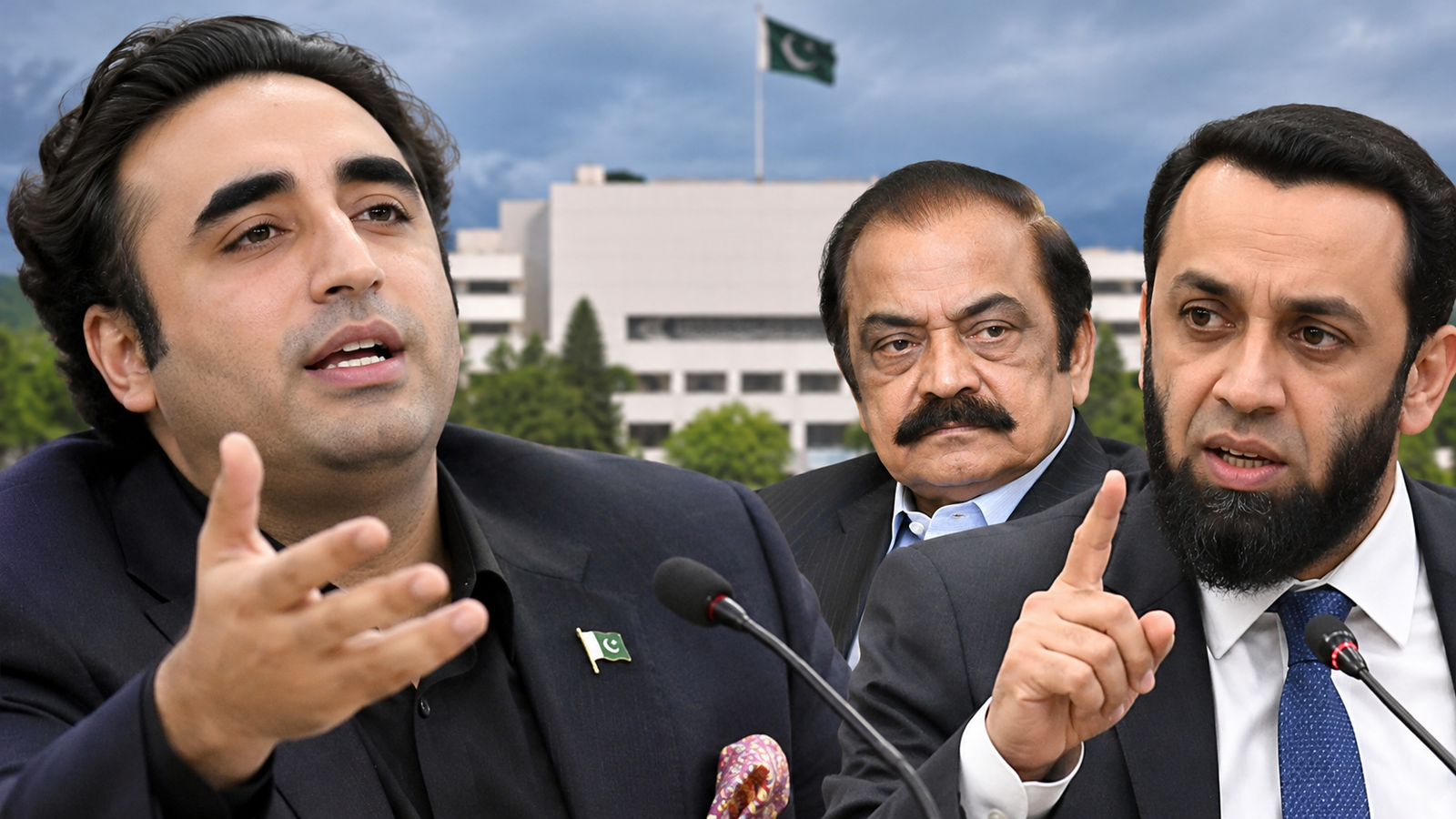
Political tensions between Pakistan’s two major ruling coalition partners, the Pakistan Muslim League-Nawaz (PML-N) and Pakistan Peoples Party (PPP), have escalated following a series of sharp exchanges over the proposed creation of new provinces, constitutional amendments and the future of the country’s political system.
PPP Chairman Bilawal Bhutto Zardari’s strongly worded criticism of the federal government has triggered an equally forceful response from senior PML-N figures, exposing growing differences between the coalition partners over provincial autonomy, democratic governance and the distribution of political power.
The confrontation intensified after Bilawal, speaking at a Meet the Press event at the Karachi Press Club, warned that any attempt to divide Sindh through force could lead to bloodshed and widespread unrest.
His remarks prompted Federal Information Minister Attaullah Tarar to question why a democratic debate over new provinces should be linked to violence, while Prime Minister’s Adviser on Political Affairs Rana Sanaullah suggested that Bilawal’s statements about the 27th Constitutional Amendment could potentially expose him to disqualification.
The exchange has raised questions about the stability of the ruling alliance, particularly as the PPP continues to support Prime Minister Shehbaz Sharif’s government while increasingly challenging its political direction.
Bilawal Warns Against Forced Division of Sindh
Bilawal delivered his strongest warning over proposals to create new provinces, particularly any move that could result in Sindh’s division without public consent.
He argued that forcing such a decision could create deep divisions within society and potentially trigger violent confrontation.
“If Sindh is divided by force, questions will be asked about the blood that flows on Karachi’s streets,” Bilawal warned.
He said that imposing provincial boundaries against the wishes of the population could turn political disagreements into hostility, with ordinary people potentially taking up arms.
The PPP chairman maintained that his party was not opposed to the creation of new provinces in principle, provided the process followed constitutional, democratic and legal procedures and reflected public consent.
He also questioned the intentions of those promoting the debate, arguing that some advocates of new provinces had never won an election and were therefore not directly accountable to voters.
Bilawal claimed that neither Prime Minister Shehbaz Sharif nor the federal cabinet had formally discussed the proposals with him.
He also criticised what he described as attempts to push the debate through unofficial channels rather than established democratic institutions.
PML-N Rejects Bilawal’s Warning, Calls for Public Referendum
Federal Information Minister Attaullah Tarar responded sharply, saying that discussions about new provinces and improved governance could not be stopped simply because a political party opposed them.
Tarar said he found it difficult to understand why Bilawal had spoken about possible bloodshed over a constitutional and political debate.
He argued that the people of Pakistan should have the right to determine whether new provinces were needed to improve governance and public service delivery.
“If the people of Pakistan want new provinces, they should be created,” Tarar said.
The information minister suggested that a referendum could be an appropriate mechanism for determining public opinion, stressing that democratic decisions should reflect the wishes of citizens rather than political parties alone.
He questioned how political leaders could decide the future of Sindh, Punjab, Balochistan or Khyber Pakhtunkhwa without consulting their populations.
However, Bilawal rejected the referendum argument, pointing to Pakistan’s history of referendums under undemocratic governments and insisting that the Constitution already provides a procedure for altering provincial boundaries.
Under Article 239(4) of Pakistan’s Constitution, a constitutional amendment altering the limits of a province requires approval by a two-thirds majority of the total membership of the concerned provincial assembly.
The disagreement therefore extends beyond the political desirability of new provinces to the constitutional process and the question of who has the authority to initiate such changes.
PML-N Questions PPP’s Dual Role in Government and Opposition
Tarar also accused the PPP leadership of adopting contradictory political positions by enjoying the benefits of participation in the ruling arrangement while publicly criticising the same system.
He questioned whether a party could simultaneously share responsibility for governance and distance itself from the government’s shortcomings.
“We are part of the same government. Why don’t we sit together and talk?” Tarar asked.
The minister argued that both parties had been part of Pakistan’s political system for decades and could not simply disassociate themselves from its institutional failures.
He also challenged Bilawal’s criticism of accountability institutions, pointing out that the PPP had itself supported reforms to the National Accountability Bureau (NAB).
Tarar maintained that political criticism should not become a means of avoiding accountability.
His remarks highlighted an increasingly visible contradiction within the coalition: the PPP continues to support the federal government while positioning itself as a critic of some of its most controversial policies.
Bilawal Calls for Political Reset, Says System Has Been Deliberately Weakened
Beyond the provincial controversy, Bilawal launched a broader attack on Pakistan’s political and institutional framework, arguing that the system had not simply collapsed but had been deliberately weakened.
He called for a “political reset” beginning with parliament rather than another non-political intervention.
According to Bilawal, restoring public confidence in democratic institutions must become a national priority.
He acknowledged that he, too, shared responsibility for the deterioration of the political system.
The PPP chairman said the opposition had lost confidence in parliament and that rebuilding this trust was primarily the government’s responsibility.
He also called for the release of political prisoners and renewed dialogue with opposition parties, including Pakistan Tehreek-e-Insaf (PTI).
Bilawal said he considered PTI founder Imran Khan a political prisoner and questioned why former prime ministers in Pakistan repeatedly ended up behind bars.
He urged the government to engage PTI in discussions, particularly on national security and counterterrorism.
Bilawal also suggested that governor’s rule in Khyber Pakhtunkhwa could end if political cooperation on counterterrorism became possible.
His comments marked a significant shift in tone towards the opposition at a time when his own party is increasingly at odds with the PML-N over governance and constitutional issues.
27th Constitutional Amendment Becomes New Flashpoint
Another major point of confrontation emerged over Bilawal’s criticism of the 27th Constitutional Amendment.
The PPP chairman alleged that the amendment had been passed through what he described as a “forced majority” rather than genuine political consensus.
He contrasted the process with the 26th Constitutional Amendment, which he said had been negotiated through mutual understanding despite political disagreements.
Bilawal also referred to the resignations of senior judges following the 27th Amendment, arguing that the developments reflected a loss of confidence in the judicial system.
He accused the political establishment of weakening institutions rather than rebuilding public trust.
His remarks drew an unusually strong response from Rana Sanaullah, the prime minister’s adviser on political affairs.
Speaking on Geo News’ programme Capital Talk, Sanaullah suggested that Bilawal’s assertion about the amendment being passed under pressure could create legal difficulties for the PPP chairman.
He argued that if a political leader claimed to have voted for a constitutional amendment under coercion, such a statement could potentially raise questions about that leader’s eligibility to remain in office.
Sanaullah also pointed out that Bilawal was a member of the Judicial Commission established under the 27th Amendment and therefore benefited from the institutional arrangements he was now criticising.
These were Sanaullah’s political and legal assertions; no court determination establishing grounds for Bilawal’s disqualification was cited.
Rana Sanaullah Says Sindh Issue Behind Bilawal’s Anger
Despite his criticism, Sanaullah acknowledged that the proposed division of Sindh was a particularly sensitive issue for the PPP.
He suggested that Bilawal’s remarks were driven largely by anger over the provincial restructuring debate.
Sanaullah said the PML-N had long been aware of the PPP’s reservations about any proposal affecting Sindh’s territorial integrity.
His comments indicated that the coalition leadership recognises the political sensitivity of the issue, even as senior ministers publicly challenge the PPP’s position.
For the PPP, Sindh remains its principal electoral stronghold, making any proposal to divide the province a potentially significant political challenge.
Bilawal Questions Prime Minister’s Authority Over His Ministers
Bilawal also directed criticism at the functioning of the federal government, suggesting that Prime Minister Shehbaz Sharif should exercise greater control over his cabinet.
“We made Shehbaz Sharif prime minister, and I want him to succeed,” Bilawal said.
However, he added that a prime minister should have sufficient authority to control his own ministers.
His remarks appeared to reflect frustration with federal ministers publicly advancing proposals that the PPP says have not been formally discussed within the coalition.
Bilawal also questioned the federal government’s handling of provincial financial resources.
He alleged that provinces were not receiving their rightful share of certain revenues, including petroleum levy proceeds, and claimed that the amount involved was approximately Rs1.7 trillion.
The claim was presented as Bilawal’s position and was not accompanied by an independent fiscal assessment in the supplied material.
PPP Chairman Criticises Economy, Media Restrictions and Accountability System
Bilawal’s criticism extended to economic management, corruption and restrictions on the media.
He said ordinary Pakistanis were struggling with rising living costs and accused political leaders of focusing on confrontation rather than addressing public hardship.
The PPP chairman argued that corruption remained one of Pakistan’s fundamental problems but that there was little genuine political commitment to tackling it.
He also criticised what he described as selective accountability, claiming that individuals aligned with powerful institutions often escaped scrutiny.
On media freedom, Bilawal said journalists were working under increasing pressure and feared consequences for reporting uncomfortable truths.
He called for the restoration of confidence in the Election Commission, parliament and the judiciary, arguing that elections could not enjoy public legitimacy without trust in the institutions responsible for conducting them.
What Does the Growing Rift Mean for the Coalition?
The latest exchange exposes a growing political divide between the PML-N and PPP, two parties whose cooperation has been central to the current federal governing arrangement.
Although the PPP continues to support the prime minister, Bilawal’s remarks suggest mounting frustration over constitutional changes, provincial autonomy and the government’s approach towards opposition parties.
The PML-N, meanwhile, appears unwilling to allow the PPP to distance itself from decisions taken under the ruling arrangement.
Tarar’s criticism of the PPP’s simultaneous participation in government and opposition-style rhetoric, coupled with Sanaullah’s warning over possible disqualification, indicates that the disagreement has moved beyond routine coalition differences.
Three major issues now define the confrontation: the proposed creation of new provinces, the legitimacy of recent constitutional amendments and the broader question of political accountability.
For the PPP, protecting Sindh’s territorial integrity remains a central political priority. For the PML-N, the debate over new provinces is being presented as a matter of public choice and improved governance.
The disagreement also reflects competing political calculations, with both parties seeking to protect their electoral interests while avoiding direct responsibility for the weaknesses of the existing system.
