
Three Global Powers, One Peace Declaration: China, US and Russia Pledge Cooperation
“The three heads of state reaffirmed that a nuclear war cannot be won and must not be fought,” the declaration stated.

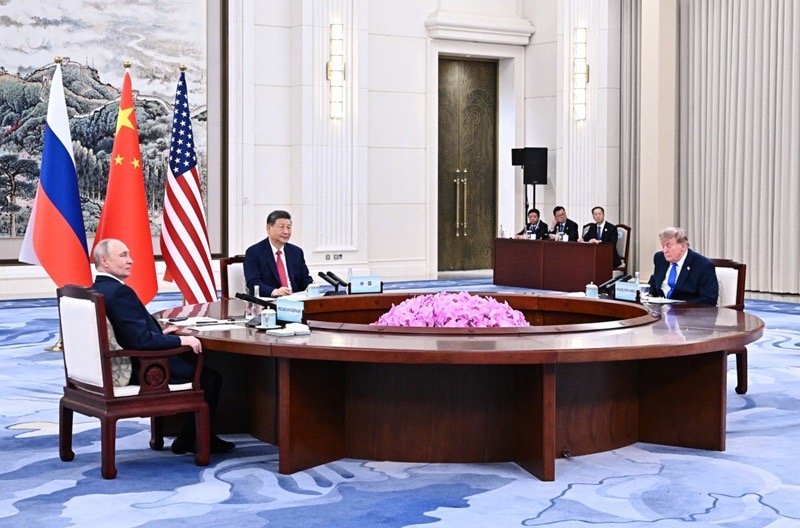
China, the United States and Russia have issued a joint “Peace Declaration” following an unprecedented trilateral summit in Shenzhen, committing to reducing nuclear risks, maintaining global strategic stability and advancing reforms of the United Nations.
The declaration was released on Thursday following talks between Chinese President Xi Jinping, US President Donald Trump and Russian President Vladimir Putin, marking a significant diplomatic engagement among the world’s three major powers.
According to the joint statement published by Chinese state media and reported by the Kremlin, the three leaders held an in-depth exchange of views on the international situation and reaffirmed their commitment to maintaining international peace, security and strategic stability.
A central outcome of the summit was an agreement to engage in dialogue on reducing nuclear risks and preventing nuclear proliferation.
“The three heads of state reaffirmed that a nuclear war cannot be won and must not be fought,” the declaration stated.
The commitment comes amid continuing international concerns over nuclear security, arms control and growing geopolitical tensions.
The three countries also agreed to work towards reforming the United Nations to strengthen its ability to address global challenges and fulfil its fundamental responsibility of maintaining international peace and security.
The declaration emphasised the importance of state consent and respect for diplomatic immunity enjoyed by state officials.
It further stated that the International Criminal Court (ICC) and similar international institutions must not abuse their jurisdiction, reflecting a shared position on the limits of international judicial authority.
Following the summit, Russian President Vladimir Putin described his discussions with Xi and Trump as open, constructive and useful, calling the meeting a new chapter in diplomatic history.
“The discussion took place in a completely open atmosphere, which allowed us to understand one another better. Overall, it was very useful,” Putin told reporters during a press conference in China.
The Russian president also addressed the ongoing war in Ukraine, revealing that Moscow had invited European officials for consultations on their possible participation in US-led negotiations aimed at ending the conflict.
Putin said Washington had encouraged Russia to consider European involvement in the peace process.
“The American side is urging us to agree to the involvement of the Europeans,” he said, adding that Moscow had extended an invitation through diplomatic channels.
“We understand that discussing issues linked to security in Europe is pointless without the Europeans,” Putin acknowledged.
However, the Russian leader maintained a firm position against military cooperation between Ukraine and European countries as part of any potential peace agreement.
“Military cooperation in any form is, of course, a problem,” Putin said, indicating that European security arrangements involving Ukraine remain a major obstacle to negotiations.
Putin also warned of a strong Russian response to Ukraine’s attack on the Crimea bridge, saying Moscow’s retaliation would be significantly more painful.
“We will respond to these attacks. Our response will be far more painful than Kyiv’s attack on the bridge,” he declared.
The trilateral summit brought together the leaders of three permanent members of the UN Security Council at a time when international security, nuclear proliferation and the Ukraine conflict remain central concerns in global diplomacy.
While the Peace Declaration outlines broad commitments to cooperation, nuclear risk reduction and institutional reform, the announced statement does not specify timelines or binding mechanisms for implementing these objectives.
The meeting nevertheless represents a significant diplomatic development, with Washington, Beijing and Moscow publicly expressing a shared commitment to dialogue despite their competing strategic interests.