
Shehbaz Sharif Tells UNGA Haramain Is Pakistan’s ‘Red Line’
Addressing the 81st session of the United Nations General Assembly in New York, the prime minister said Pakistan stood in complete solidarity with the people of Saudi Arabia

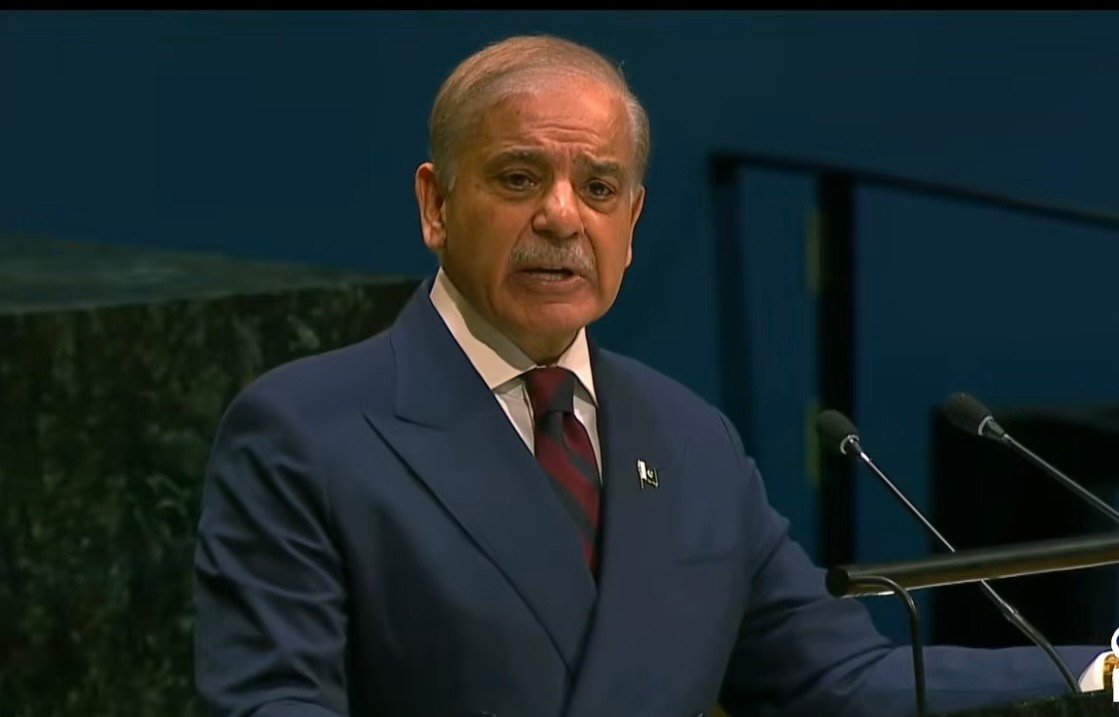
Prime Minister Shehbaz Sharif on Friday declared the security and sanctity of the Two Holy Mosques a “red line” for Pakistan, strongly condemning recent attacks against Saudi Arabia and saying the Makkah Joint Defence Agreement between Pakistan, Saudi Arabia and Türkiye was aimed at strengthening regional peace, stability and collective defence.
Addressing the 81st session of the United Nations General Assembly in New York, the prime minister said Pakistan stood in complete solidarity with the people of Saudi Arabia following recent attacks, including an attempted drone strike targeting Makkah.
“The sanctity and security of the Two Holy Mosques cannot be compromised. The Haramain Sharifain are a red line for us,” Shehbaz said.
He described the Makkah Joint Defence Agreement between Pakistan, Saudi Arabia and Türkiye as a historic arrangement, stressing that the trilateral alliance was “not against any country” but reflected the three countries’ collective commitment to defence, stability and peace in the region.
Diplomacy Must Prevail Amid Regional Conflict
The prime minister said war had engulfed the Gulf and wider Middle East since February, resulting in loss of life, economic damage and severe pressure on critical maritime routes, including the Strait of Hormuz.
Shehbaz said Pakistan responded to the crisis through diplomatic efforts, including bringing Washington and Tehran to the negotiating table in Islamabad.
He paid tribute to Field Marshal Syed Asim Munir for his role on the diplomatic and defence fronts and acknowledged peace efforts by Saudi Arabia, Türkiye, Qatar, Egypt, China and other friendly countries.
Amid renewed escalation, Shehbaz said the “voice of diplomacy must grow louder” than missiles, drones and guns, stressing that major global trade arteries, including the Strait of Hormuz and Bab el-Mandeb, must remain open.
Pakistan-India Conflict, Kashmir and Water
Referring to Pakistan’s confrontation with India last year, Shehbaz said Pakistan had faced what he described as unprovoked Indian aggression and that the armed forces, under Field Marshal Asim Munir’s leadership, had responded professionally.
He also acknowledged US President Donald Trump’s intervention in helping halt fighting between the two nuclear-armed states.
Turning to Kashmir, Shehbaz called for a just resolution of the Jammu and Kashmir dispute and said Kashmiris had looked towards the United Nations for eight decades for fulfilment of their right to self-determination.
“Jammu and Kashmir is Pakistan’s jugular vein and will always remain so,” he said, reiterating Pakistan’s political, diplomatic and moral support for Kashmiris.
The prime minister also criticised India’s unilateral move concerning the Indus Waters Treaty, calling it illegal and saying water could not be used as a weapon. He warned that any attempt to stop or divert Pakistan’s water would be treated as an act of war.
Shehbaz Reiterates Support for Palestinian State
On Palestine, Shehbaz said generations of Palestinians had struggled for freedom and that a child born in Gaza had the same right to life as a child born anywhere else in the world.
He expressed concern over Israeli military actions extending into the occupied West Bank and accused Israel of pursuing the forced displacement of Palestinians.
Pakistan, he said, continued to support the establishment of an independent Palestinian state based on the pre-1967 borders, with Al-Quds Al-Sharif as its capital.
He also condemned ongoing Israeli military actions against Lebanon and Syria.
Terrorism Remains Major Global Threat
Shehbaz described terrorism as a grave threat to international peace and security, saying Pakistan had stood on the front line of the fight against terrorism.
He said Pakistan had lost nearly 100,000 lives and suffered approximately $150 billion in economic losses in its fight against terrorism.
The prime minister said the sacrifices of Pakistan’s armed forces and civilians had contributed to making the world safer and should be recognised by the international community.
He also alleged that the TTP, which Pakistan refers to as “Fitna al-Khawarij”, and the BLA, which the government refers to as “Fitna al-Hindustan”, were using Afghan territory to carry out attacks against Pakistan.
Pakistan Reaffirms Commitment to UN Charter
Opening his address, Shehbaz said it was an honour to represent Pakistan’s 240 million peace-loving people at the UN General Assembly for the fourth time.
Quoting verse 61 of Surah Al-Anfal “And if they incline to peace, then incline to it” — the prime minister said the pursuit of peace remained one of humanity’s greatest endeavours.
He also invoked Quaid-e-Azam Muhammad Ali Jinnah’s vision regarding the United Nations and reaffirmed Pakistan’s commitment to the UN Charter, international peace and global prosperity.
Shehbaz said the unanimous adoption of UN Security Council Resolution 2788 reflected Pakistan’s commitment to international peace, arguing that dialogue and diplomacy must remain at the centre of efforts to resolve conflicts in an increasingly volatile world.