
PPC Brief: Azerbaijan Protests, Musk Funding, Ethiopia-Eritrea Tensions
These developments reflect a broad range of global challenges, from religious freedom debates and restrictions on public demonstrations to rising regional security tensions and international intelligence threats.

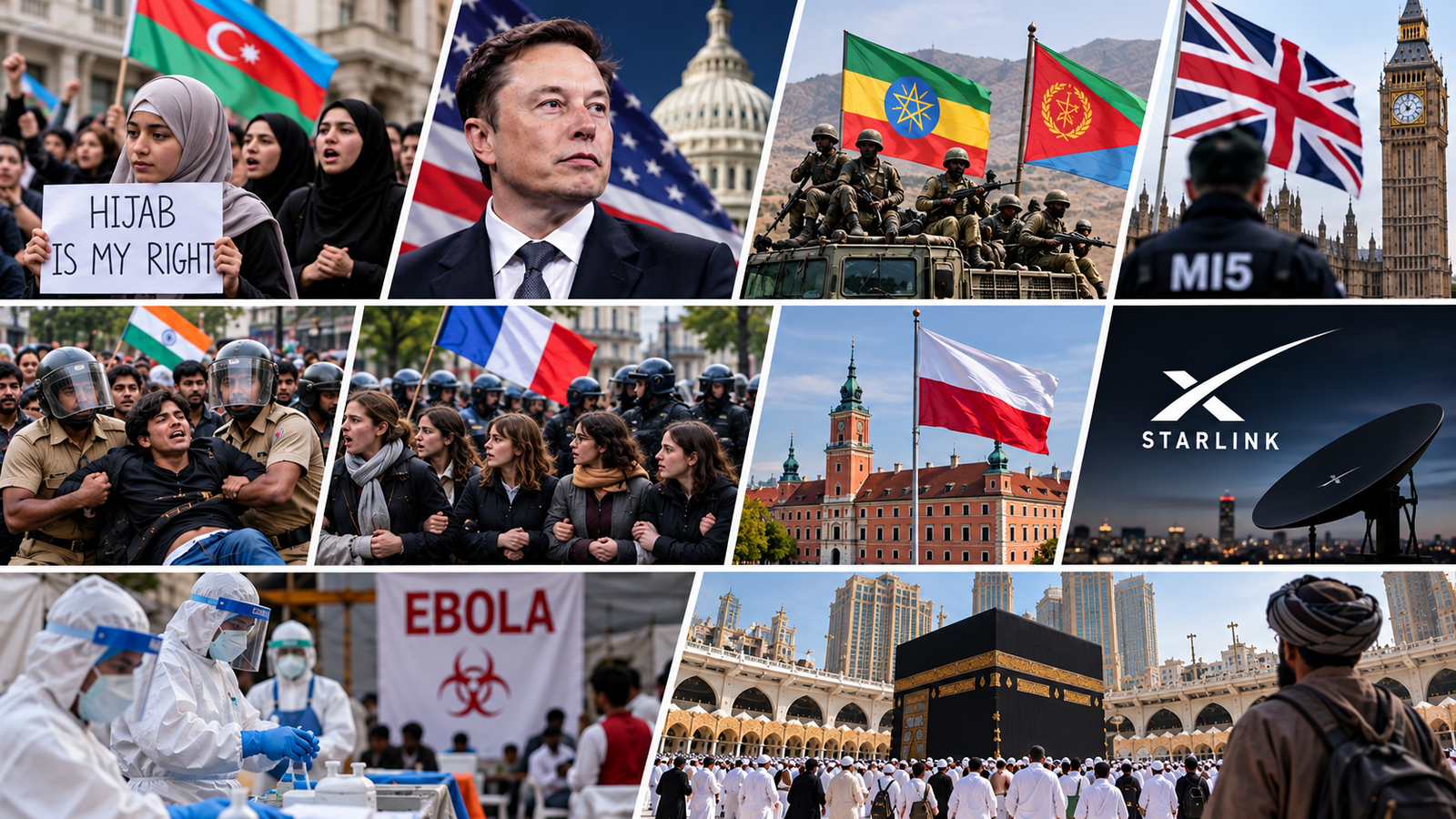
From protests over school dress restrictions in Azerbaijan and Elon Musk’s massive financial contributions to the US Republican Party to escalating tensions between Ethiopia and Eritrea, several developments are shaping the international news agenda.
Meanwhile, British intelligence has warned of growing threats from Iran and Russia, student demonstrations continue in India and France, and Saudi Arabia’s revised Umrah entry rules offer new travel opportunities for Afghan citizens. Here are ten major international developments.
1. Protests Erupt in Azerbaijan Over School Hijab Restrictions
Protests have erupted in Azerbaijan following government restrictions affecting the wearing of hijabs by female students and teaching staff in schools.
According to Arab media, an amendment approved last month does not explicitly mention a hijab ban. However, it prohibits clothing in schools that authorities consider inconsistent with the state’s secular principles.
The restrictions have triggered demonstrations over religious dress in educational institutions.
2. Elon Musk Becomes Republican Party’s Largest Financial Backer for US Midterms
Billionaire Elon Musk has emerged as the largest financial contributor to Donald Trump’s Republican Party ahead of the US midterm elections.
According to a Financial Times report, Musk’s financial contributions to the Republican Party have reached approximately $366 million since January 2025.
The report further revealed that Musk has donated more than $275 million to Republican election funds since July this year alone.
3. Eritrean Troops Suffer Heavy Losses as Ethiopian Forces Advance Toward Border
Military tensions between Ethiopia and Eritrea have intensified, with Eritrean troops reportedly suffering heavy losses and retreating toward their border.
A spokesperson for an Ethiopian pro-government militia told AFP that Eritrean forces were withdrawing following significant casualties.
Meanwhile, Ethiopian government troops have advanced into a border town previously controlled by Tigrayan rebels, according to people in contact with local residents.
Diplomatic efforts are underway to prevent the escalating confrontation from developing into a wider war between the two Horn of Africa neighbours.
4. MI5 Warns Iran and Russia Are Escalating Threats Against Britain
Britain’s domestic intelligence agency MI5 has warned that Iran is intensifying efforts to target more heavily protected locations, including military installations in the United Kingdom.
MI5 Director General Ken McCallum said Iran was increasingly attempting to strike harder targets, while Russia was expanding its hybrid warfare activities against countries supporting Ukraine.
The warning highlights growing security concerns over threats to British military and strategic interests.
5. Police Detain Student Protesters in New Delhi Over Restrictions on Demonstrations
Police detained student protesters in New Delhi as demonstrations intensified over restrictions on public protests at Jantar Mantar.
The students demanded the restoration of Jantar Mantar’s status as an authorised protest site, accusing the Indian government of restricting their right to protest.
The demonstrations focused on demands for the restoration of public protest rights at the site.
6. Teachers and Parents Form Human Chain to Protect Student Protesters in Paris
Teachers, parents and other demonstrators formed a human chain in front of riot police to shield protesting students during demonstrations in Paris.
The incident occurred amid nationwide school protests across France.
The human chain was formed as protesters sought to protect students participating in the demonstrations.
7. Polish Court to Rule on Detention of Suspect in Alleged Plot Against Senior Ministers
A Polish court is expected to decide on Wednesday whether to extend the detention of a man suspected of planning an attack targeting the country’s prime minister and defence minister.
According to prosecutors, improvised explosive materials were discovered in the suspect’s apartment.
The court’s decision will determine whether the suspect remains in custody as the investigation continues.
8. Hindu Nationalist Group Urges India to Block Elon Musk’s Starlink
An influential Hindu nationalist organisation closely associated with India’s ruling party has urged the government to prevent Elon Musk’s Starlink from launching satellite internet services in the country.
The group raised national security concerns while opposing the proposed launch of Starlink services in India.
The development adds another dimension to the debate surrounding the company’s entry into the Indian telecommunications market.
9. Ebola Cases in DR Congo Surpass 9,000 as Health Responders Struggle
The number of confirmed Ebola cases in the Democratic Republic of Congo has exceeded 9,000, according to government data released on Tuesday.
Health responders are struggling to slow transmission across multiple hotspots as the outbreak continues to pose serious public health challenges.
The rising case count reflects the difficulties faced by response teams in containing the spread of the disease.
10. Saudi Arabia’s Revised Umrah Entry Rules Open New Opportunities for Afghans
Saudi Arabia’s recent changes to Umrah entry rules have created new travel opportunities for Afghan citizens who have faced years of restrictions on international mobility.
For years, Afghans have encountered significant travel barriers, including closed embassies, limited visa availability and a shrinking number of countries they could visit.
The Kingdom’s revised Umrah entry arrangements have now opened a pathway that many Afghan citizens previously considered inaccessible.
These developments reflect a broad range of global challenges, from religious freedom debates and restrictions on public demonstrations to rising regional security tensions and international intelligence threats. While political funding and emerging technologies continue to influence national policy debates, public health emergencies and changing travel regulations remain equally significant for communities across the world.