
Power Bank Catches Fire on IndiGo Flight, Forces Emergency Landing
A power bank caught fire at 35,000 feet, forcing an IndiGo flight to divert to Hyderabad. Why are lithium-ion batteries dangerous in checked luggage, and what should passengers know before flying?

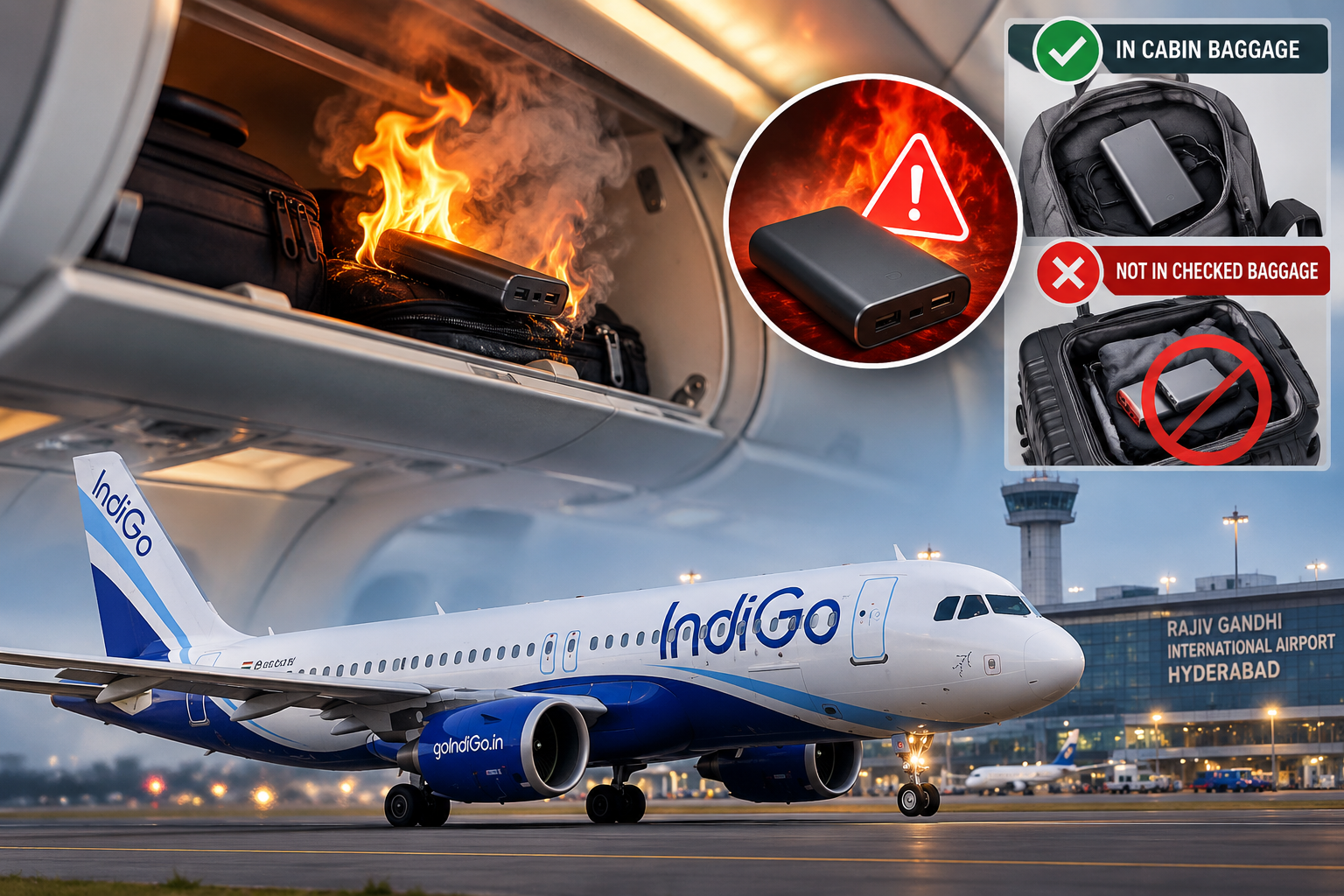
An IndiGo passenger flight travelling from Delhi to Chennai was diverted to Hyderabad after a power bank caught fire inside an overhead cabin compartment at an altitude of 35,000 feet, triggering an emergency situation aboard the aircraft.
The incident occurred on IndiGo flight 6E6115, operated by an Airbus A321 aircraft, when a power bank stored in the overhead luggage compartment reportedly caught fire during the journey.
The cabin crew responded immediately and successfully extinguished the fire using onboard firefighting equipment. However, as a precautionary measure and in accordance with aviation safety procedures, the pilots diverted the aircraft to the nearest suitable airport in Hyderabad.
The aircraft landed at Rajiv Gandhi International Airport, where it was grounded following the incident. Passengers were subsequently accommodated on an alternative aircraft to continue their journey to Chennai.
Why Are Power Banks Dangerous on Aircraft?
Power banks contain lithium-ion batteries, which can pose serious fire hazards if damaged, overheated, short-circuited or exposed to excessive heat.
One of the major risks associated with lithium-ion batteries is a phenomenon known as thermal runaway, a chain reaction in which a battery generates excessive heat that can lead to smoke, fire or even an explosion.
Once thermal runaway begins, the heat generated inside the battery can spread to neighbouring cells, making the fire difficult to control and increasing the risk of reignition.
Why Are Power Banks Prohibited in Checked Baggage?
International aviation safety regulations generally prohibit passengers from placing spare lithium-ion batteries, including power banks, in checked baggage.
The primary concern is that a battery fire inside an aircraft’s cargo hold may not be detected or addressed as quickly as one occurring in the passenger cabin.
Although aircraft cargo compartments are equipped with fire detection and suppression systems, lithium-ion battery thermal runaway can present challenges because batteries may continue generating heat or reignite.
In contrast, when a power bank is carried in cabin baggage, flight attendants can quickly identify smoke, overheating or flames and take immediate action using appropriate firefighting procedures.
For this reason, aviation authorities, including the International Air Transport Association (IATA) and the US Federal Aviation Administration (FAA), require spare lithium batteries and power banks to be carried in cabin baggage rather than checked luggage.
What Are the Rules for Carrying Power Banks on Flights?
Under widely followed international aviation safety guidelines:
- Power banks must be carried in cabin baggage, not checked baggage.
- Power banks rated up to 100 watt-hours (Wh) are generally permitted, subject to airline restrictions.
- Batteries rated between 100 Wh and 160 Wh may require airline approval, although some airlines prohibit power banks above 100 Wh.
- Power banks exceeding 160 Wh are generally prohibited on passenger aircraft.
- Passengers should protect power banks from short circuits, physical damage and excessive heat.
- Airlines may impose additional restrictions on using, charging or storing power banks during flights.
Passengers are advised to check the specific airline’s battery safety policy before travelling.
The IndiGo incident highlights the importance of strict compliance with aviation battery safety regulations, particularly as the use of portable charging devices continues to grow among air travellers worldwide.