
Handcuffing the Guardians: What the KP Police Act 2026 Really Takes Away
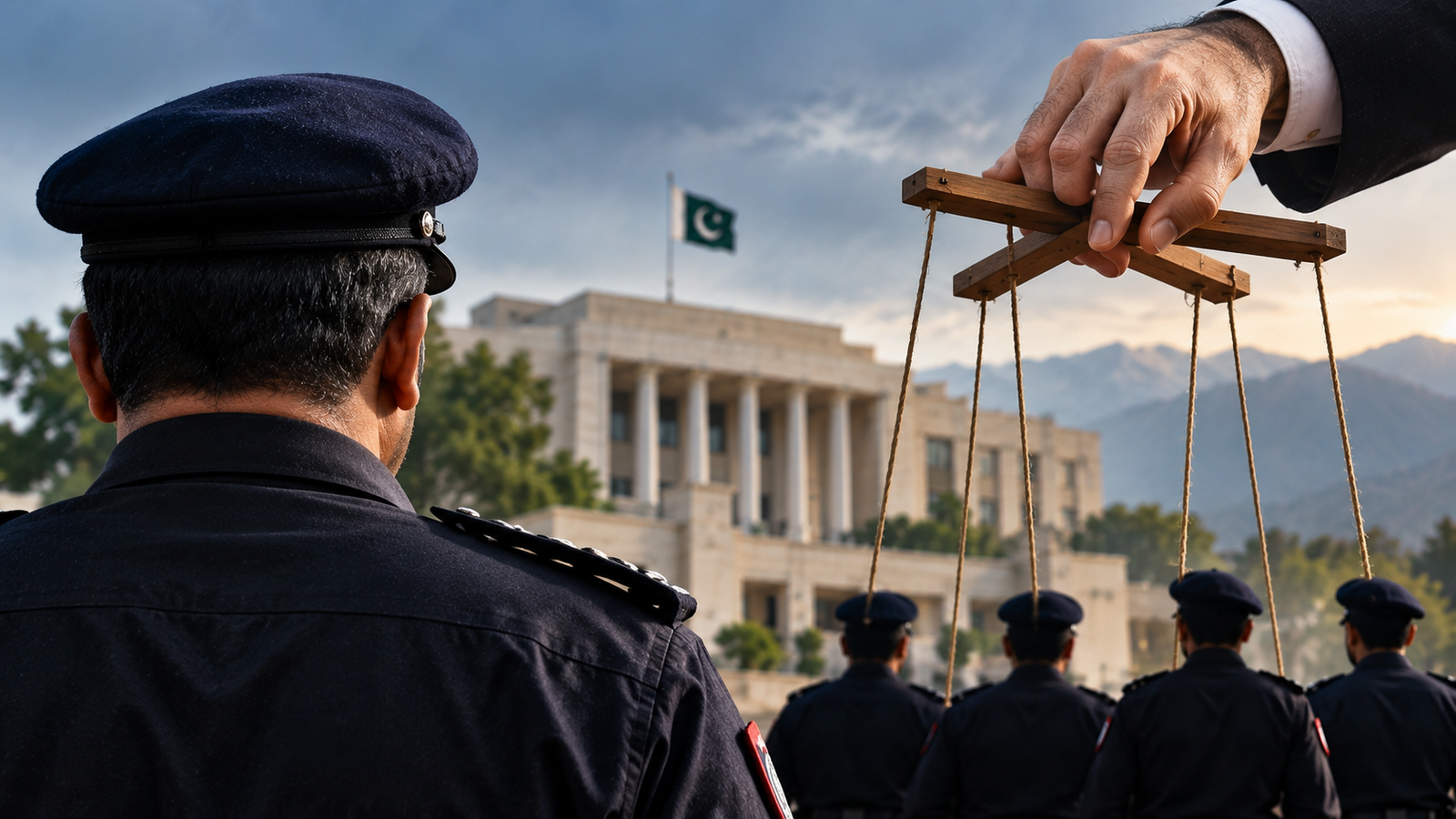
The Act takes the powers that make a police chief a commander and hands them to the Chief Minister's office and the provincial secretariat.

On 23 September, the Khyber Pakhtunkhwa cabinet approved the Police Act 2026. The government calls it reform. Read the text, and it looks more like a return to old habits.
The Act takes the powers that make a police chief a commander and hands them to the Chief Minister’s office and the provincial secretariat. What remains is an Inspector General who wears the uniform but cannot pick his own officers. This is not a new idea.
The colonial state built policing on the same principle: the police should answer to whoever holds power, not to the law.The details matter, because the damage is in them. Under the new law, the Chief Minister will post and transfer Superintendents of Police, Senior Superintendents and Additional Inspectors General.
He will also approve the choice of District Police Officers. Deputy and Assistant Superintendents will be transferred by the Home Secretary, a civil servant. Notifications for senior police appointments will come from the Administration Department.
The Police Policy Board used to be chaired by the IGP. It will now be chaired by the Chief Minister, and the annual provincial policing plan will need his approval. If the government is “dissatisfied” with the IGP’s performance, it can ask Islamabad for new names. In misconduct cases, it can have the IGP’s services withdrawn. Most revealing of all, the police can no longer answer a court in their own name. Every response must first be cleared by the Law Department and the Advocate General’s Office.
Put these provisions together, and the result is plain. The IGP keeps formal “operational control” on paper. But command without control over postings is only a title. A district officer who knows that his transfer depends on the Chief Minister’s office and the Home Secretary’s file will look to those offices, not to his own chain of command.
This is not the province’s first attempt. In 2024, KP amended the celebrated Police Act of 2017 so that postings of senior officers needed the Chief Minister’s approval. In February 2026, a Division Bench of the Peshawar High Court struck those amendments down.
The Bench, headed by Chief Justice S.M. Attique Shah, held that they had “dismantled the operational autonomy indispensable to a professional police service.” It said the police had been repositioned as “an instrument of political expediency rather than a servant of the law.”
The Court described a depoliticised, functionally autonomous police as “a constitutional necessity,” not an administrative convenience. Internal management, operations, postings and transfers, it held, belong to the IGP. The government’s role is superintendence.
Seven months later, the province has not accepted that ruling. It has tried to legislate around it. Rather than amend the 2017 law, the government has repealed it and brought back, under a new title, the very provisions the Court found unconstitutional. When a government’s answer to a constitutional judgment is to redraft the same thing, it tells us what it wants: control, not reform.
To see why this matters, go back to 1861. After the uprising of 1857, the British needed a police force that would keep order for the Crown, not protect the rights of its subjects. The Police Act of 1861 created a force under “dual control.” The police officer handled the force’s internal affairs.
The District Magistrate, who was also the Collector and the district’s chief executive, directed it. The same officer who collected revenue also tried cases and commanded the constabulary. Keeping executive, judicial and policing power in one set of hands was the whole purpose. An empire does not share authority with the people it governs.
Independence changed the flag but not that arrangement. The Police Order of 2002 and, more boldly, the KP Police Act of 2017 tried to dismantle it. The 2017 law gave the IGP real administrative and financial authority. It set up public safety and complaint mechanisms and community-based dispute resolution councils.
Its promise was simple: professional policing, insulated from political pressure and answerable through independent oversight. For a few years, KP’s police were cited across Pakistan as proof that reform could work.
The 2026 Act reverses that promise. It gives power back to the same two groups that have always resisted an independent police: politicians who want a pliant force, and administrators who have never accepted losing the Deputy Commissioner’s old supremacy.
For some in the administrative cadre, control of the police is only half the ambition. The other half has been the steady campaign to revive executive magistracy and bring back the combined judicial and executive authority of the colonial district officer. That combination is exactly what the Constitution’s principle of separating the judiciary from the executive was meant to end.
A secretariat that controls who commands the police, and a district administration that wants to control who sits as magistrate, together rebuild the Raj in modern language. That is what they are keeping in Azad Jammu & Kashmir, Gilgit-Baltistan and Islamabad Capital Territory, and the results are obvious. The colonial mindset is resisting the inevitable changes in the name of legacy, but at the cost of public service and professionalism.
Nobody argues that the police should answer to no one. The question is who they answer to, and for what. Developed democracies settled this long ago with one distinction: elected governments set policy, budgets and priorities, and police chiefs run operations.
In England and Wales, elected Police and Crime Commissioners set priorities and can hold a chief constable to account. But the law protects the chief constable’s operational independence, including direction and control of officers. Japan places its police under public safety commissions so that no single minister can direct them.
Across mature democracies, oversight is plural, institutional and transparent: legislatures, independent inspectorates, complaint authorities and courts. It is not concentrated in one office that also depends on votes.
KP’s new law erases that distinction. It does not strengthen oversight. It replaces oversight with ownership.
Supporters of the Act argue that police misused their powers during raids and arrests after 9 May 2023, and that elected leaders must be able to restrain an overbearing force. Police abuse is real and must be punished. But the answer to abuse is accountability: independent complaint authorities, judicial review and transparent disciplinary processes. The answer is not giving the ruling party control over every district police chief’s career.
Governments change. The same powers that protect one party today can be used against it tomorrow. A police force that serves whoever sits in the Chief Minister’s House cannot serve the citizen, the victim or the rule of law.
There is also a practical cost. KP faces serious terrorist violence, and effective counter-terrorism depends on command, continuity and discipline. An officer who can be moved on a political whim will not build intelligence networks, invest in a district, or take on local power brokers. The province’s front line cannot afford a command structure run from the secretariat.
The Provincial Assembly should not pass this law in its present form. Postings and transfers must stay with the IGP, within a fixed-tenure framework. Accountability should be real and institutional, run by independent bodies rather than departments under political control. And the police must keep the right to speak for themselves in court, as the law’s servants.
The choice facing KP is the one the subcontinent has faced since 1861: whether the police exist to serve power or to serve the public. The Peshawar High Court has already answered that. The Assembly now has the chance to agree with it, or to take the province back to colonial-era policing.