
Four Countries, One MoU: Will Badr Deliver Tech Transfer or Just Tea Meetings?
All four Badr participants have different strengths. Türkiye has capabilities in drones, armoured vehicles and naval systems.

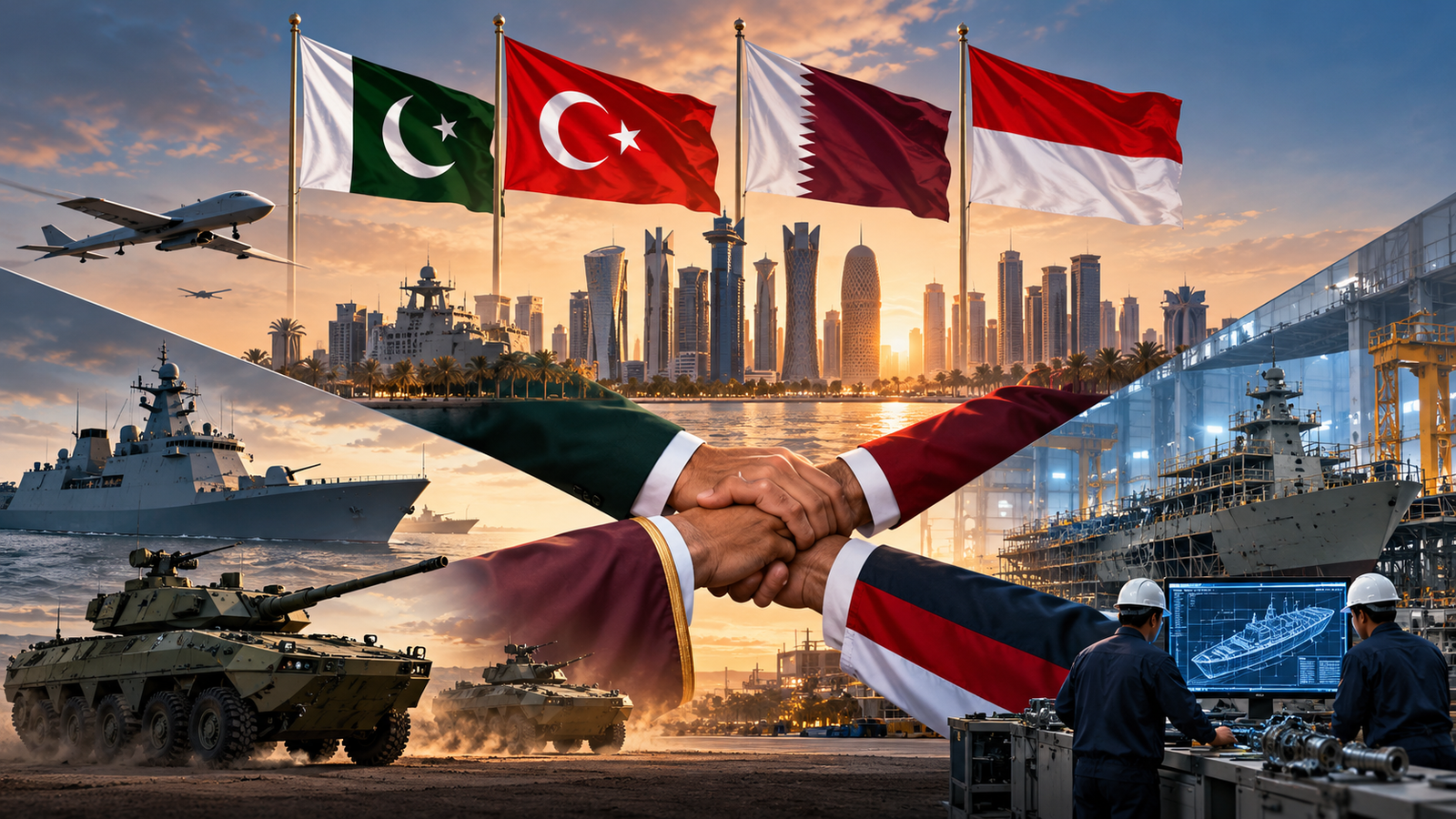
A defence agreement is easy to celebrate on the day it is signed. Its value emerges when countries can design, manufacture and maintain equipment they once purchased abroad. Badr offers a route towards greater military self-reliance for Pakistan. However, its success will depend on the other participating countries.
On 21 October 2026, Pakistan, Türkiye, Qatar and Indonesia signed the Badr Memorandum of Understanding in Doha. It was signed to expand cooperation in defence production, research and development, and technology transfer. Its stated purpose is to combine the countries’ capabilities and create opportunities for collaborative production so that these countries do not have to rely on finished equipment purchased from foreign suppliers.
The significance of this MoU lies in its industrial focus. Military partnerships generally focus on exercises or training for future security threats. Such cooperation requires careful consideration of who will develop the technology, manufacture the equipment and maintain it. The size of their armed forces is also highly important for strategic autonomy.
Badr is different from other regional security arrangements. In August, Pakistan, Saudi Arabia and Türkiye signed the Makkah Joint Defence Agreement, which is different from this MoU. The Makkah Joint Defence Agreement has a condition that an armed attack against one will be regarded as an attack against all. However, the Badr MoU focuses on defence-industrial cooperation, and its framework does not establish the same collective-defence arrangement.
All four Badr participants have different strengths. Türkiye has capabilities in drones, armoured vehicles and naval systems. Pakistan has manufacturing capacity across several defence sectors. Indonesia has its own industrial base and experience in defence projects. Qatar’s financial resources provide significant support for collaboration. These strengths matter only if used in the right direction.
Pakistan and Türkiye have historic defence ties. Their formal defence cooperation expanded through the High-Level Military Dialogue Group, established in 2003, while their subsequent collaboration has included naval shipbuilding under the MILGEM corvette programme. Türkiye and Indonesia also have defence projects. These relationships were a starting point, but now four-country projects will need careful coordination.
For Pakistan, its main opportunity is to convert cooperation into domestic capacity. Technology transfer could strengthen local expertise and create skilled jobs. It could also reduce delays and restrictions imposed by foreign suppliers. However, the key thing to note is that purchasing equipment from a partner is not the same as having the ability to produce it independently. Domestic assembly does not automatically provide control over critical software or advanced manufacturing methods. The real benchmark should be what the country gains in terms of technical knowledge and long-term maintenance capability.
This MoU also presents practical challenges. The public announcement does not yet provide a detailed roadmap. It has not yet provided project schedules, financing commitments or rules governing intellectual property. The countries will need clear rules on costs, production responsibilities, technology protection and dispute resolution so that delays, cost overruns and disputes over benefits can be avoided.
Self-reliance, in this evolving era, does not mean abandoning international partnerships. Modern defence systems depend on complex global supply chains, and even joint production may rely on imported components. A pragmatic approach is to diversify suppliers and develop domestic expertise.
The Badr MoU is an opportunity, not a finished achievement. If it produces jointly developed systems, meaningful technology transfer, skilled employment and dependable supply chains, it could strengthen the strategic autonomy of its member countries. If its primary focus remains on meetings only, then its impact will be limited. The decisive factor for Pakistan is what the country will be able to design, manufacture and maintain because of it. The real test of Badr will begin after the signing ceremony.