
CPEC Explained: Phase I, Phase II and Major Projects
CPEC is a long-term economic cooperation framework between Pakistan and China and a flagship component of Beijing’s Belt and Road Initiative (BRI).

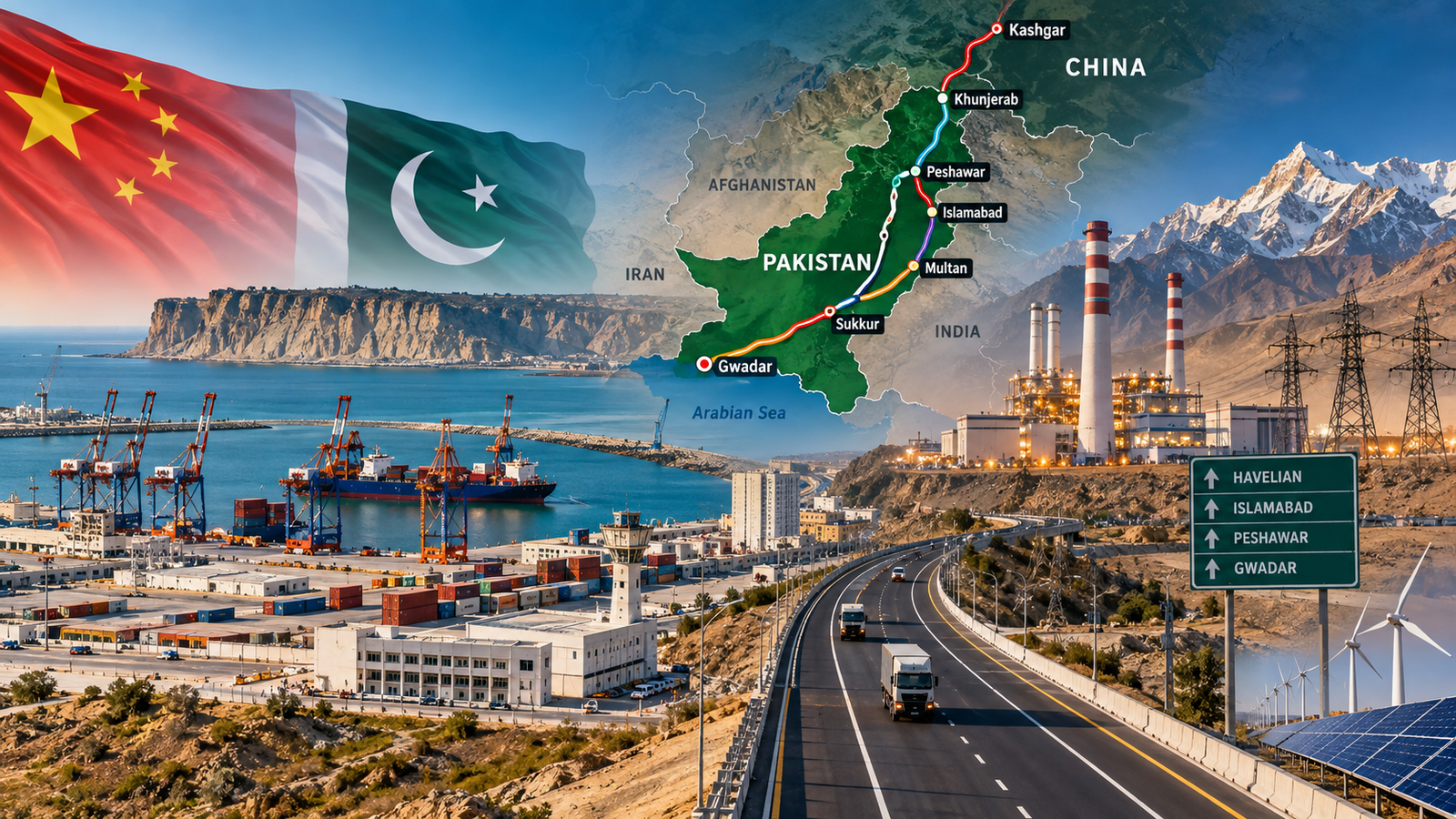
More than a decade after its launch, the China-Pakistan Economic Corridor (CPEC) is moving from its first phase of large-scale energy and transport infrastructure towards a broader second phase centred on industrialisation, agriculture, technology, mining, green development and private-sector investment.
CPEC is a long-term economic cooperation framework between Pakistan and China and a flagship component of Beijing’s Belt and Road Initiative (BRI). It seeks to improve Pakistan’s transport and energy infrastructure while expanding trade, investment and economic connectivity between China and Pakistan.
The corridor connects China’s western Xinjiang region with Pakistan’s Arabian Sea coast, with Gwadar occupying an important place in the broader connectivity framework.
While Phase I became best known for power plants, motorways and other major infrastructure projects, CPEC Phase II increasingly referred to as CPEC 2.0 is intended to shift greater attention towards industries, Special Economic Zones (SEZs), business-to-business cooperation and sectors capable of generating exports and employment.
When Did CPEC Begin?
The foundations of CPEC were laid in 2013, when Pakistan and China agreed to develop an economic corridor linking the two countries.
The programme gained significant momentum during Chinese President Xi Jinping’s state visit to Pakistan in April 2015, when the two countries signed agreements and memoranda covering dozens of projects. The package was initially widely described as being worth around $46 billion, although the portfolio and estimated value changed as projects were subsequently added, modified or reprioritised.
CPEC became one of the most prominent components of the BRI, China’s global infrastructure and connectivity initiative.
Rather than being a single road or individual project, CPEC is an umbrella framework encompassing energy, highways, railways, ports, industrial cooperation, digital connectivity and socioeconomic projects.
What Was CPEC Phase I?
The first phase of CPEC was largely designed around some of Pakistan’s most pressing infrastructure constraints at the time: electricity shortages, inadequate transport networks and limited connectivity.
Consequently, energy and transport received the largest early investments.
Pakistan and China developed or financed coal, hydropower, solar and wind projects, electricity transmission infrastructure, motorways and highways, while work also proceeded on Gwadar-related projects.
Phase I therefore provided the physical infrastructure upon which the second stage of economic cooperation was expected to develop.
Energy: A Major Pillar of Phase I
Energy was among the largest components of early CPEC.
Projects included coal-fired plants at Sahiwal, Port Qasim and Hub, alongside renewable and hydropower projects.
The Quaid-e-Azam Solar Park in Punjab and wind-energy projects in Sindh formed part of the renewable-energy portfolio, while major hydropower schemes included projects such as Karot.
The Matiari-Lahore high-voltage direct-current transmission line became another major component of the energy infrastructure developed under the wider CPEC framework, strengthening the country’s ability to transmit electricity over long distances.
CPEC’s energy portfolio helped add substantial generation capacity to Pakistan’s power system, although the sector subsequently became part of a broader debate over capacity payments, electricity tariffs, circular debt and the financial sustainability of Pakistan’s power sector.
Roads and Motorways
Transport infrastructure was another defining feature of CPEC Phase I.
One of its most prominent projects is the Multan-Sukkur section of the Peshawar-Karachi Motorway, a roughly 392-kilometre motorway providing a major north-south transport connection.
The Havelian-Thakot section of the Karakoram Highway was also developed as part of improved connectivity towards Pakistan’s northern border with China.
CPEC’s road network has generally been discussed through eastern, western and central alignments designed to improve connectivity between different parts of Pakistan and eventually facilitate movement towards Gwadar.
For Pakistan, the objective extends beyond China-bound traffic: improved highways can reduce domestic travel times and logistics costs and connect production centres with markets and ports.
Gwadar: The Maritime Component of CPEC
Gwadar’s relationship with China predates the formal launch of CPEC.
Development of Gwadar Port began in 2002 with Chinese assistance, and its first phase was completed in 2007. The port was subsequently incorporated into the much larger CPEC connectivity framework.
Located on Pakistan’s Arabian Sea coast in Balochistan, Gwadar is envisaged as a maritime trade and logistics hub with potential links to western China, Central Asia and the Middle East.
CPEC-related development in Gwadar has included the port, road connectivity and supporting infrastructure, while plans have also focused on the Gwadar Free Zone and associated economic activity.
Other projects have included the New Gwadar International Airport, inaugurated in 2024, and infrastructure intended to improve the city’s connectivity and services.
However, Gwadar has also become central to debates about whether large infrastructure investments are translating quickly enough into employment, water, electricity and wider economic opportunities for the local population.
ML-1: CPEC’s Major Railway Ambition
One of the largest proposed CPEC transport projects is the upgrading of Pakistan Railways’ Main Line-1 (ML-1).
ML-1 runs from Karachi to Peshawar and forms the backbone of Pakistan’s railway network.
The proposed upgrade has remained under discussion for years because of its enormous scale, financing requirements and technical complexity. Pakistan and China have repeatedly discussed restructuring and implementing the project in stages.
Unlike several early CPEC power and road projects, ML-1 has therefore remained a major planned but not fully implemented component of the corridor.
This distinction is important when assessing CPEC: the overall portfolio includes completed projects, projects under construction and large schemes that remain at planning or financing stages.
Digital Connectivity
CPEC has not been limited to physical roads and power plants.
The Pakistan-China Cross-Border Optical Fiber Cable, running from Khunjerab towards Rawalpindi, created another international telecommunications route for Pakistan and demonstrated the digital-connectivity dimension of the corridor.
Digital infrastructure is expected to receive greater attention as cooperation moves deeper into CPEC 2.0.
From Phase I to Phase II
With much of the early focus placed on building infrastructure, Pakistan and China increasingly began describing the next stage as one centred on industrial and economic activity built around that infrastructure.
That transition forms the basis of CPEC Phase II, or CPEC 2.0.
The central question for the second phase is therefore different from that of the first.
Phase I was largely about building power and connectivity infrastructure. Phase II is intended to focus more heavily on using that infrastructure to produce goods, attract investment, expand exports and create employment.
Special Economic Zones and Industrialisation
Special Economic Zones are consequently among the most important elements of Phase II.
Three SEZs have repeatedly featured prominently in CPEC planning:
Rashakai Special Economic Zone in Khyber Pakhtunkhwa, Allama Iqbal Industrial City in Faisalabad, Punjab, and Dhabeji Special Economic Zone in Sindh.
The objective is to attract Chinese and other investors into manufacturing and encourage industrial relocation and joint ventures with Pakistani companies.
Potential sectors range from textiles and engineering to chemicals, food processing, automobiles and other export-oriented industries.
Progress, however, has varied between zones, and industrialisation has proceeded more slowly than some of the infrastructure construction undertaken during Phase I.
CPEC 2.0 and the Five Corridors
Pakistan and China have increasingly framed CPEC’s next stage around five corridors: a Growth Corridor, Livelihood-Enhancing Corridor, Innovation Corridor, Green Corridor and Open/Inclusive Regional Development Corridor.
Together, they broaden CPEC beyond traditional infrastructure.
The new phase envisages deeper cooperation in agriculture, technology and innovation, industry, digital connectivity, education, livelihoods and sustainable development.
Agriculture and Food Security
Agriculture is expected to become an increasingly important area of Pakistan-China cooperation.
Potential areas include modern farming technology, improved seeds, agricultural mechanisation, irrigation, food processing, storage and agricultural exports.
For Pakistan, greater value addition is particularly important. Rather than exporting primarily raw agricultural products, investment in processing and supply chains could allow Pakistani businesses to sell higher-value products domestically and internationally.
Mining and Minerals
Mining has also emerged as a major potential component of the evolving Pakistan-China economic relationship.
Pakistan possesses significant mineral resources, but inadequate infrastructure, exploration and processing capacity have historically constrained the sector.
Future cooperation could include mineral exploration, extraction, processing and value addition, although individual mining projects may fall under separate investment arrangements rather than automatically constituting formal CPEC projects.
Technology, Innovation and Digital Economy
CPEC 2.0 is also intended to expand cooperation into science and technology.
Pakistan and China have discussed collaboration in information technology, artificial intelligence, digital infrastructure, research, innovation and emerging technologies.
This represents a significant change from the physical-infrastructure-heavy model associated with the early years of CPEC.
Scientific cooperation, including areas related to space technology and satellite applications, has also become part of the expanding Pakistan-China relationship.
Green Development
The Green Corridor concept places greater emphasis on environmental sustainability, renewable energy and climate-related cooperation.
This is particularly significant because the original CPEC energy portfolio included several coal-based projects at a time when Pakistan urgently needed additional generating capacity.
The evolving framework increasingly emphasises renewable energy, green technology, environmental protection and sustainable development.
From Government-to-Government to Business-to-Business
Another important change in CPEC 2.0 is the growing emphasis on business-to-business, or B2B, cooperation.
Many Phase I projects were driven by agreements between the Pakistani and Chinese governments, state-owned companies and major financial institutions.
The second phase aims to bring more private companies into the relationship through joint ventures, industrial partnerships and direct investment.
For Pakistan, the success of this model will depend heavily on the business environment, policy continuity, energy costs, taxation, availability of foreign exchange and investors’ ability to repatriate profits.
How Is CPEC Financed?
CPEC is frequently described simply as Chinese “investment” or, conversely, as Chinese “debt”. Neither description accurately covers the entire programme.
CPEC uses different financing models.
Some projects involve foreign direct investment, particularly independent power projects. Others have involved concessional or commercial loans, government-backed financing or grants.
As a result, the headline value of CPEC should not be interpreted as a single loan transferred by China to the Pakistani government.
At the same time, Pakistan does owe debt to Chinese institutions, and Chinese financing forms part of the country’s broader external debt obligations.
The financial debate therefore requires distinguishing between CPEC project investment, government borrowing, power-sector liabilities and Pakistan’s overall bilateral debt to China.
Security Remains One of CPEC’s Biggest Challenges
Security has emerged as one of the most serious challenges facing CPEC and broader Chinese investment in Pakistan.
Chinese nationals and CPEC-linked projects have been targeted in terrorist attacks over the years, prompting Beijing repeatedly to raise concerns about the protection of its citizens and investments.
Pakistan has established dedicated security arrangements for Chinese personnel and projects and says protecting Chinese nationals remains a priority.
Repeated attacks, however, have added costs and risks for investors and remain a significant factor in the future expansion of Chinese private-sector investment.
Has CPEC Delivered?
CPEC’s first phase produced visible infrastructure, particularly in power generation, electricity transmission, highways and connectivity.
Supporters argue that these investments helped Pakistan address severe electricity shortages, modernise transport infrastructure and create foundations for industrial growth.
Critics, meanwhile, have questioned the financial terms of some projects, the pace of industrialisation, power-sector liabilities, project delays and whether the economic benefits have been distributed sufficiently across Pakistan.
The two perspectives concern different aspects of a programme that has evolved considerably since its launch.
The more important test of Phase II will be whether infrastructure built during the first decade can translate into sustained investment, competitive industries, exports, productivity gains and employment.
CPEC’s Next Chapter
More than a decade after its inception, CPEC is no longer simply a collection of Chinese-backed power plants and highways.
Its proposed second phase represents an attempt to transform the corridor into a broader economic partnership spanning manufacturing, agriculture, technology, mining, green development and private investment.
Some flagship projects remain incomplete or under negotiation, while SEZ-led industrialisation has yet to reach the scale originally envisioned.
CPEC 2.0 will therefore be judged less by the number of new roads inaugurated and more by whether Pakistan can convert improved infrastructure and its economic relationship with China into productive investment, exports, jobs and sustainable long-term growth.