
WEF Highlights Case for New Provinces in Pakistan to Improve Governance
The WEF-published analysis argues that administrative boundaries play a crucial role in governance.

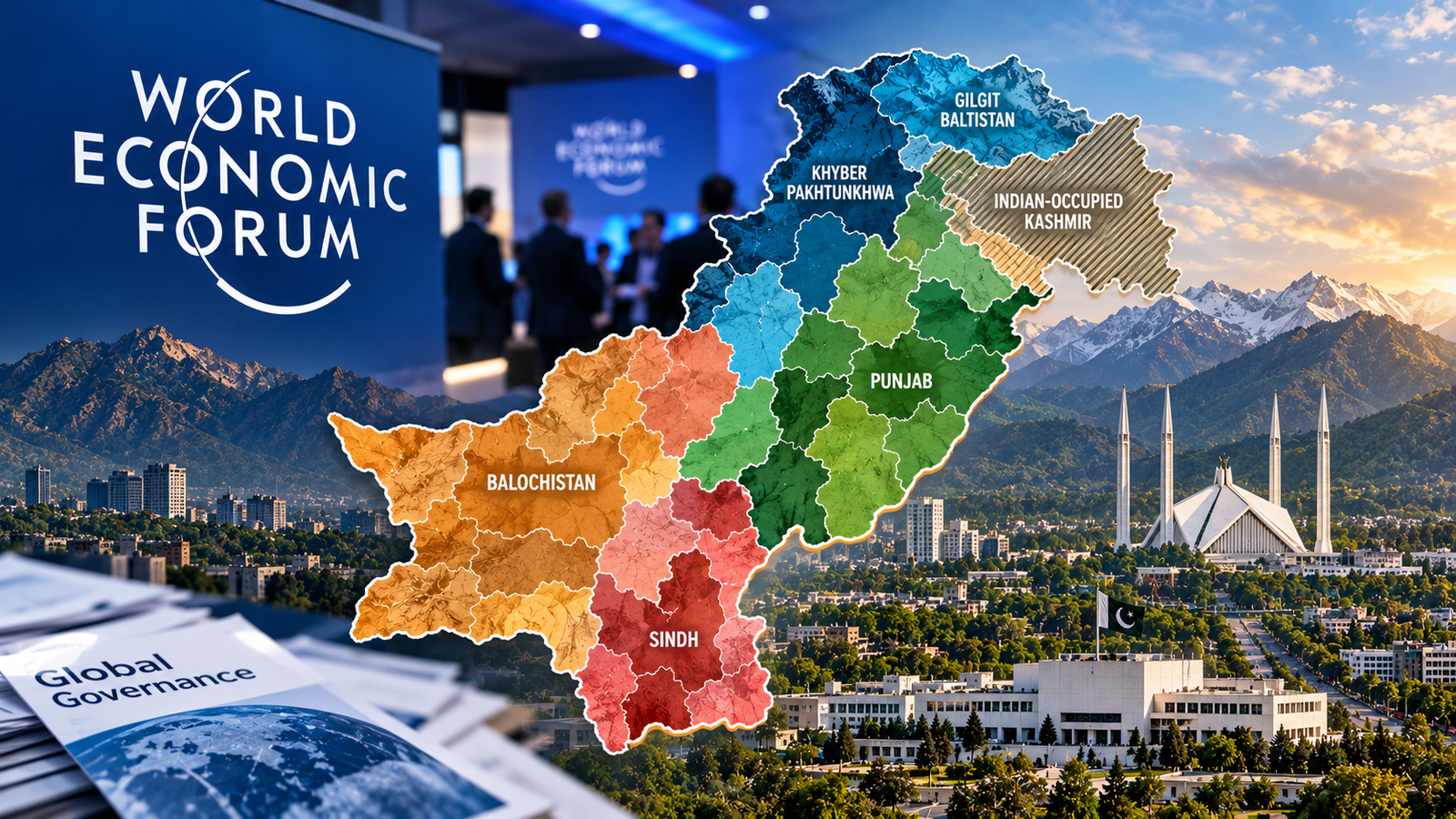
A World Economic Forum (WEF) analysis has highlighted the case for restructuring Pakistan’s existing four-province administrative system. It suggests that smaller, financially empowered administrative units could improve governance, public services and regional development as the country’s population continues to grow.
Pakistan’s population has increased more than sevenfold since 1951, reaching approximately 260 million. However, the country continues to operate through four main provinces, despite significant differences in population, geography and economic development.
Punjab alone has around 128 million residents. In contrast, Balochistan has fewer than 15 million people, although it covers a much larger geographical area.
The WEF-published analysis argues that administrative boundaries play a crucial role in governance. They determine how governments distribute resources, develop infrastructure, deliver public services and respond to emergencies.
As populations expand, decision-making often becomes increasingly distant from local communities. Consequently, citizens may struggle to access government institutions and hold authorities accountable.
Pakistan’s Growing Population Puts Pressure on Four-Province System
Pakistan has already introduced major decentralisation reforms through the 18th Constitutional Amendment and the seventh National Finance Commission (NFC) Award.
These reforms transferred important responsibilities, including health and education, to provincial governments. The NFC Award also increased the provincial share of federal tax revenues from 47.5 percent to 57.5 percent.
However, many administrative and financial decisions remain concentrated in provincial capitals. As a result, districts and local communities often struggle to benefit fully from decentralisation.
The WEF analysis highlights major disparities in education as an example.
According to the Planning Commission’s District Education Performance Index, none of the 134 assessed districts achieved the highest performance category.
Meanwhile, approximately 28 percent of children aged five to 16 remain out of school nationwide. The figure ranges from 21 percent in Punjab to 45 percent in Balochistan.
These differences highlight the challenges of delivering effective public services across regions with vastly different needs.
WEF Analysis Examines 16 to More Than 30 Administrative Units
The WEF-published analysis examines several possible models for restructuring Pakistan’s administrative system.
One proposal involves dividing each existing province into four smaller units. This would create 16 provinces and reduce the average population per unit from approximately 60 million to 15 million.
A second model considers creating between 23 and 25 provinces based on population distribution and geographical coherence.
A more extensive approach would build on existing civil divisions to establish more than 30 administrative units.
According to the analysis, smaller provinces could bring government institutions, development budgets and decision-making closer to citizens.
Moreover, they could improve local representation, infrastructure planning and public service delivery.
However, these models are governance scenarios rather than approved government proposals. Each would involve political, constitutional and financial challenges.
How Other Countries Restructured Their Administrative Systems
The WEF analysis also examines international examples of administrative restructuring.
Nigeria expanded from three regions at independence to 12 states in 1967 and eventually 36 states by 1996.
Similarly, Indonesia increased its provinces from 27 in 1991 to 38 today.
Kenya replaced its eight provinces with 47 elected county governments in 2013.
In Indonesia, Nigeria and Brazil, the average population of first-tier administrative units is approximately six to eight million. Pakistan’s average stands at around 60 million per province.
Kenya offers a particularly relevant example because its restructuring went beyond changing administrative boundaries.
The country also introduced elected county governments, constitutionally protected responsibilities and formula-based revenue transfers.
However, Lebanon provides a contrasting example. Despite having more than 1,000 municipalities, many local authorities lack the financial resources and institutional capacity needed to deliver services effectively.
Therefore, the analysis cautions that increasing administrative units alone does not guarantee better governance.
Financial Decentralisation Remains a Major Challenge
The WEF-published analysis identifies weak provincial revenue collection as another major challenge for Pakistan.
During the 2024–25 financial year, provincial taxes generated approximately Rs983 billion. This represented less than 0.9 percent of Pakistan’s gross domestic product.
Meanwhile, agriculture contributes around 24 percent of economic value added but has historically remained undertaxed.
Citing International Monetary Fund estimates, the analysis notes that agriculture’s effective tax rate stands at approximately 0.3 percent.
Provincial tax authorities have struggled with limited administrative capacity, weak enforcement and inadequate information.
Although agricultural income tax reforms introduced in 2025 aim to address these weaknesses, their success depends on stronger institutions and improved tax administration.
Better data sharing with the Federal Board of Revenue, greater automation and stronger enforcement could also improve revenue collection.
The analysis argues that any restructuring of provincial boundaries must therefore be accompanied by financial reforms.
Without predictable funding, clear responsibilities and effective institutions, smaller provinces could simply reproduce existing governance problems.
Smaller Provinces Could Improve Governance and Public Services
The WEF analysis also links administrative reform with Pakistan’s growing economic and environmental challenges.
The country faces recurring floods, water shortages, rapid urbanisation and increasing pressure to create employment opportunities for young people.
Smaller and better-resourced administrative units could help governments respond more effectively to these challenges.
For example, local authorities could develop infrastructure according to regional needs, improve disaster preparedness and design economic policies around local resources.
Moreover, administrative decentralisation could create opportunities for new political and administrative leadership.
However, the analysis warns against creating additional provinces without adequate financial and institutional capacity.
The objective should not simply be to increase the number of administrative units. Instead, reforms should bring authority, resources and accountability closer to citizens.
The WEF-published assessment adds an international perspective to Pakistan’s longstanding debate over creating new provinces.
It suggests that administrative structures must evolve as populations grow and economic conditions change.
For Pakistan, the central question is whether four main provinces can continue to meet the governance needs of approximately 260 million people.
The analysis does not prescribe a single ideal number of provinces. Instead, it highlights the importance of aligning administrative boundaries, financial resources and institutional responsibilities with the needs of citizens.
Ultimately, the debate is not merely about drawing new provincial boundaries. It is about making government more accessible, accountable and responsive to the people it serves.