Is the World Order Undergoing a Historic Shift?
But apparently, the tide seems to be turning, and doing so at a remarkable speed. What is fascinating about international politics is that it is constantly changing.

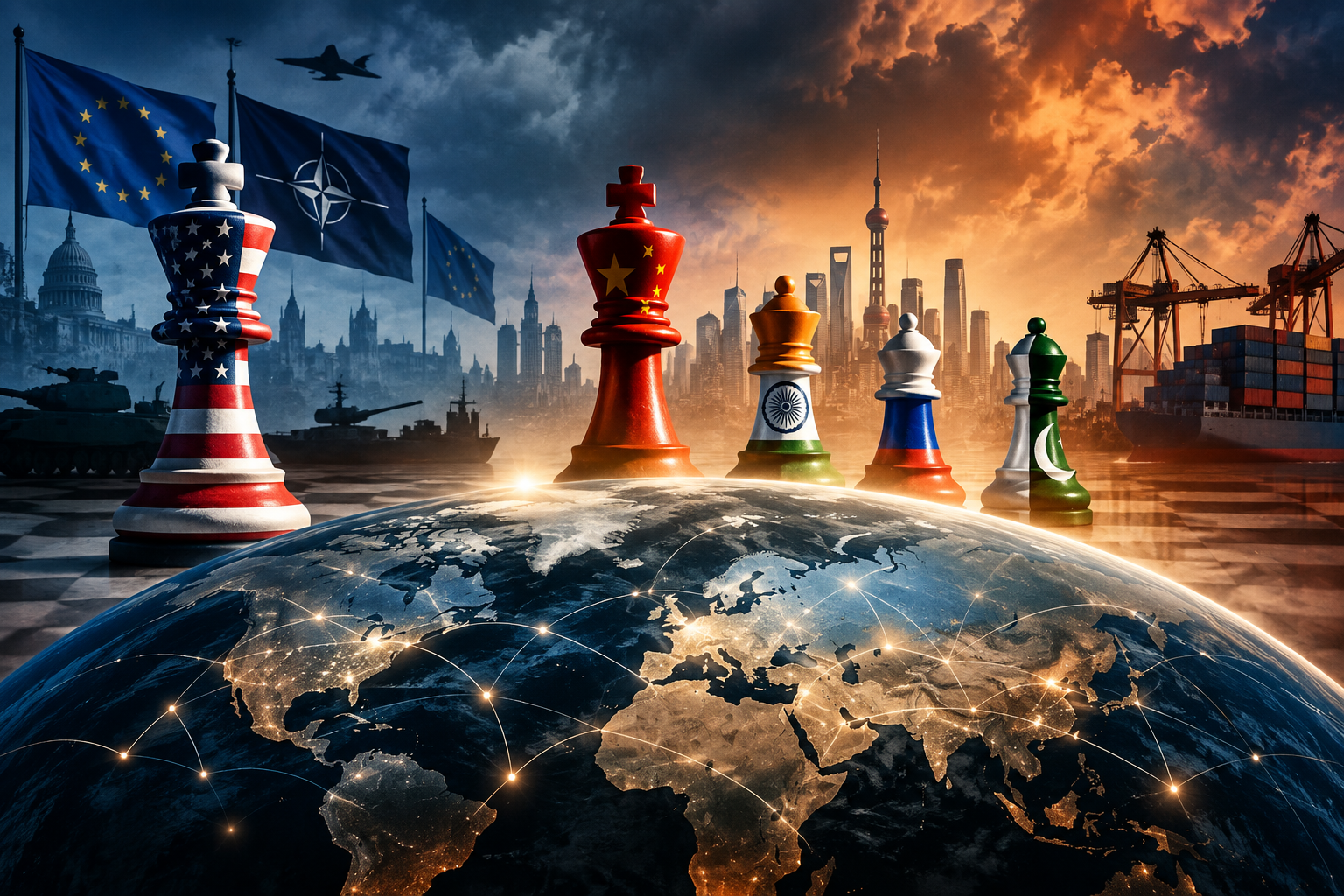
What we’ve seen in the past, after World War II, was an alliance between the United States and Europe, predominantly visible in the form of NATO. For decades, both continents have worked hand in hand, conquering and manipulating global politics to put their interests, especially in terms of national security, as a top priority while unleashing wrath and leaving debris behind in the Global South and the Middle East.
But apparently, the tide seems to be turning, and doing so at a remarkable speed. What is fascinating about international politics is that it is constantly changing. States’ behavior is becoming increasingly unpredictable. Today’s ally might become tomorrow’s adversary. Heads of state pursue their own policy agendas, for which they use various tools and tactics to obtain desired outcomes.
One such example is the current president of the United States, Donald Trump, and how he is using his tools, such as threats, sanctions and tariffs, as a Swiss knife to poke and hurt other states and to make them submit to his will in an effort to make America great again. Surprisingly, however, during all this time, the Global South has been emerging as a parallel hub for technological advancements, research and development, manufacturing and offering services, fueling its rise as booming economies.
Countries like China, Russia, Brazil, India and Pakistan are actually coming out as a parallel force in the global order, especially for Europe and Central Asia to rely on.
Recently, we have seen the United States using threats as its foreign policy strategy to influence sovereign states. All this started with Iran on the basis of nuclear weapons stockpiling, later with India getting hit with huge tariffs, almost 50% on Indian products, for buying cheap Russian oil.
Soon after, it was Nigeria, being threatened and accused of persecuting Christians living there, which, unfortunately, did not end there. In fact, the president had some New Year plans for one of the most oil-rich Latin American states, Venezuela, violating sovereignty and transgressing international borders by abducting President Nicolas Maduro Moros and first lady Cilia Adela Flores de Maduro at midnight on Jan. 3, 2026.
All of this was being observed, and Europe, along with other Western powers, was until now amazed to see how its greatest ally was putting every other resource to the best of its use. However, the happy moment was short-lived, as Trump’s repeated claims of calling Canada the 51st state of the United States were followed by his demand to annex Greenland, once politely rejected as an offer to buy it in 2019, which was considered a wake-up call. Europeans understood it was not rhetoric but rather a new demand and policy instead.
Such unfolding events were an eye-opener for Europe and Britain, and it was impossible for them to brush it under the carpet this time around. Western powers realized that all this time they backed the wrong horse and that now was the time to change course midstream, turning primarily to China and India while also keeping an eye on middle powers like Turkey and Pakistan, which are eager to showcase their potential in European and Middle Eastern markets.
Having to depend on another state renders one not only vulnerable but also weak in so many ways. Europe could not afford to look weak at a time when the U.S. appeared to have a rogue administration. And so, Canada took the lead in challenging the status quo, shifting its focus toward China by slashing 100% tariffs on Chinese electric vehicles, and China, in response, cut tariffs on Canadian canola and meal. This exchange highlights how Ottawa is strategically and decisively recalibrating its ties with Beijing.
This move by one of the closest allies of the United States was a confidence boost for others to follow in its footsteps, and the European Union responded by signing a free trade pact with India. The mother of all deals, this would be India’s biggest trade pact with Europe and one of the largest FTAs globally. It seems as though both sides are actively seeking reliable partners other than the United States.
Furthermore, the U.S. was once seen as a security provider to MENA nations, but now they have an alternative from Asia. After a four-day war between Pakistan and India, Pakistan’s military capabilities came as a pleasant surprise to the world by shooting down French-made Indian Rafales with its combat-proven JF-17 Thunders, resulting in a Saudi Arabia-Pakistan mutual defense agreement that could be expanded into a trilateral security alliance by including Turkey.
Later, with high demand for JF-17 aircraft from countries like Azerbaijan, Saudi Arabia, Libya, Indonesia, Iraq, Sudan, Bangladesh, Morocco and Ethiopia, it is evident that countries have other choices to make as well. After this episode, Pakistan is seen as a regional security stabilizer.
While discussing technological advancements in warfare, one cannot ignore China in terms of the U.S.-China technological race. Beijing is leading Washington in 66 out of 74 advanced technologies, and its tech market is broadly open to the Benelux region, which is encouraging more European countries to join this bandwagon.
Belgium’s Prime Minister Bart De Wever, while addressing a gathering at the World Economic Forum, clearly stated: “Europe is becoming digitally dependent on the U.S.,” which almost indicates that countries in Europe are definitely looking for an alternative to the United States.
Besides, in contemporary international politics, the temperature is soaring even in winter due to aggressive cross-talk between the U.S. and other NATO allies, as the president claimed that his country has given everything to NATO, whereas NATO has given nothing in return. This was rebutted first by France, which honored soldiers killed in Afghanistan who were part of NATO.
Also, the timing and remarks made by Norwegian Prime Minister Jonas Gahr Støre — that “an upcoming NATO exercise with 25,000 troops in northern Norway and Finland, mainly French and U.S. forces, shows Arctic cooperation is deepening” — were a response to what had been said about NATO earlier.
Whether the United States likes it or not, the shift appears to be in the air. Gone are the days of a unipolar system and American hegemony, or what some may call U.S. imperialism. World economies are interdependent, and the global landscape is transitioning into a multipolar system.
On the one hand, China looks confident and ambitious and is certainly building trust among others, as Western powers have engaged figures such as Irish Taoiseach Michael Martin, Canada’s Prime Minister Mark Carney, as well as the Finnish head of government.
Next was the Uruguayan president, and last week it was U.K. Prime Minister Keir Starmer who visited for talks. All of this has occurred since 2026 started. Probably they all realized that if they are not at the table, they might end up on the menu.
Lastly, the vacuum America is trying to create in the context of exiting international institutions like the World Health Organization is going to be filled by emerging powers, and we have already seen a glimpse of it during COVID-19: how China managed to provide sufficient humanitarian aid to countries worst hit by the virus, regardless of other states’ perception of Beijing in their foreign policy framework.
The irony is uncanny: the one trying to make America great again is the same one using gunboat diplomacy as a catalyst to speed up the process of the fall of U.S. hegemony.