
The Price of Existing: How Pakistan’s Tax System Reaches the Household
And behind every percentage, every levy, and every budgetary figure is a household trying to make the next month's income last until the next month's income arrives.

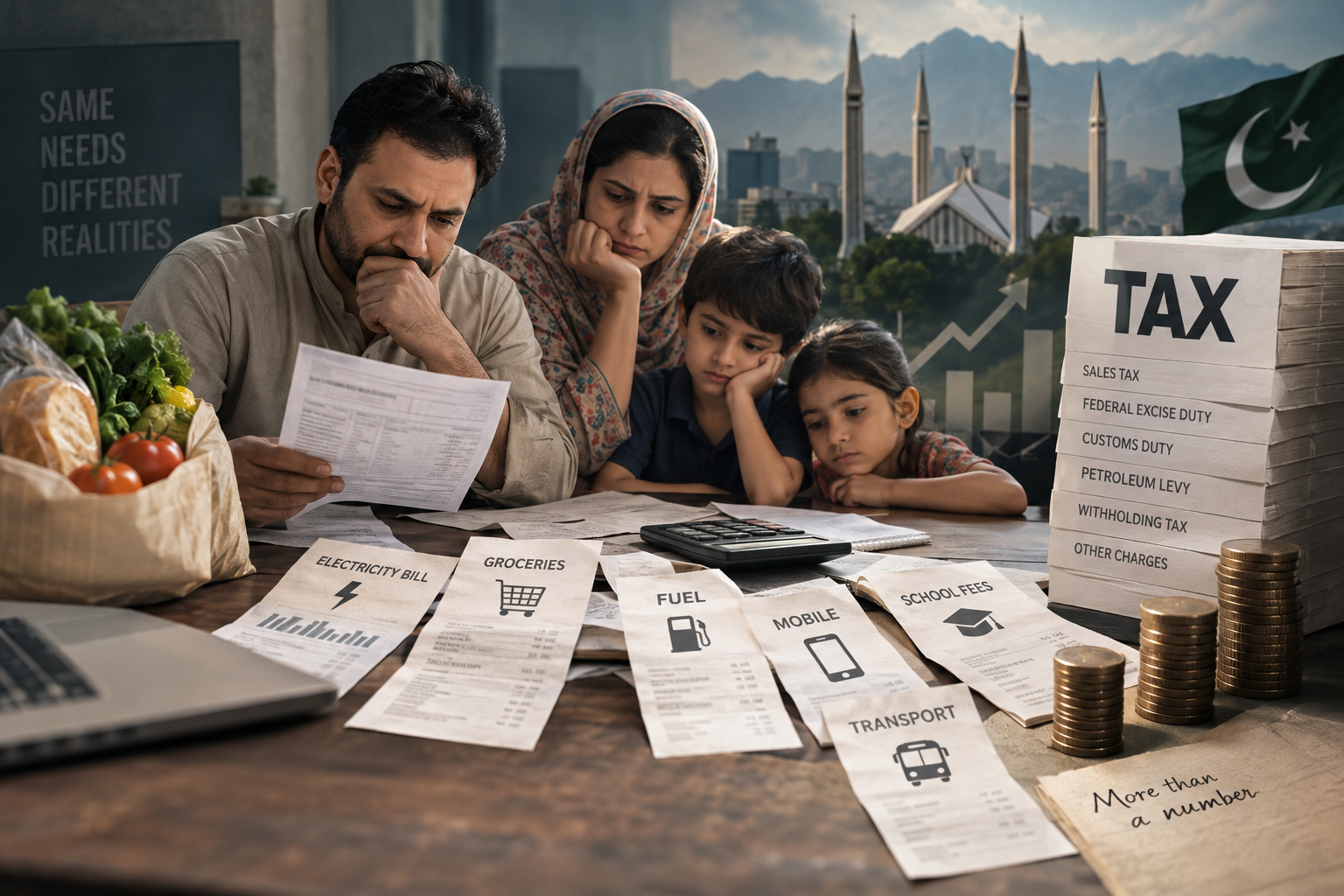
Every month, in cities and towns across Pakistan, families sit down to work out a calculation that rarely appears in discussions about taxation. It is not the calculation of how much income tax they owe the government. It is the much more immediate calculation of how much money will remain after the electricity bill is paid, the kitchen is stocked, transport is arranged, school expenses are met, and the mobile phone is recharged.
For a person earning a modest income, this calculation can be more important than the income-tax return itself.
Pakistan’s tax system provides a useful illustration of the difference between a nominal tax burden and a lived tax burden. Under the income-tax structure applicable for tax year 2026–27, taxable income up to Rs600,000 a year falls within the zero-rate slab for individuals. Above that threshold, the rates rise progressively.
On paper, this provides protection to people at the lower end of the income distribution. But being outside, or only lightly inside, the direct income-tax net does not mean that a household is outside the tax system.
The state reaches the household in other ways.
It reaches it when a family buys taxable goods. It reaches it through electricity and other utilities. It reaches it through communications and transport. It reaches it through duties, levies, withholding mechanisms, and taxes incorporated into the prices of goods and services. Some of these charges are taxes in the strict legal sense; others are levies, duties, tariff adjustments, or other components of the final price. They should not all be added together as though they were a single tax rate. But from the household’s point of view, they all matter because they affect the amount of income left after essential expenditure.
This distinction is important.
The question is not simply how much tax a citizen pays on paper. The more revealing question is how much of that citizen’s income remains available after taxation and essential consumption for saving, investment, and economic security.
That is where the distributional problem begins.
Pakistan’s tax structure is not exclusively dependent on indirect taxation. In fact, the country’s recent fiscal data show a significant increase in direct taxation. According to the Pakistan Economic Survey 2025–26, direct taxes accounted for Rs5.79 trillion of federal tax revenue in FY2025, while indirect taxes amounted to Rs5.95 trillion. Indirect taxes therefore remained slightly larger, accounting for 50.7 percent of FBR tax revenue, although their share has declined from earlier years as direct taxation has increased.
This is a more complicated picture than the familiar claim that Pakistan simply taxes consumption instead of income.
Yet the underlying concern remains.
A tax system can become burdensome for lower-income households even when the formal rate of direct income taxation is low. The reason is straightforward: people with limited incomes generally have less room to postpone consumption. Much of what they earn is already committed to necessities.
A household with a modest monthly income cannot respond to rising prices in the same way as a wealthy household. It cannot simply decide to reduce its investment portfolio, postpone the purchase of a second property, or delay a discretionary expenditure that represents a small part of its overall income. For many households, the largest part of monthly income is already allocated before the month begins.
Food has to be bought. Electricity has to be paid. Children have to travel to school. A worker has to travel to work. A telephone is increasingly necessary not only for communication but also for employment, banking, education, and access to services.
The tax burden therefore has to be understood in relation to what remains after basic consumption, not merely in relation to the rate printed beside a particular tax.
Consider two citizens purchasing the same taxable product.
The price is the same. The tax incorporated into that price may also be the same in rupee terms. But the economic significance of that payment is not the same.
For a high-income household, the expenditure may represent a small fraction of monthly income. For a lower-income household, the same expenditure may represent a meaningful share of what was available for food, education, or saving.
This is the basic reason consumption taxation can have a regressive effect.
The tax does not necessarily become legally different for the poorer citizen. Its economic weight becomes different.
That distinction is often lost in public discussion.
Take the household grocery bill. Pakistan’s sales-tax system contains both taxable and exempt supplies, and the treatment of food products varies according to their form and the applicable provisions of the law. The Sales Tax Act, for example, provides exemptions for a number of basic food items and unprocessed agricultural products, while other products are subject to different treatments.
It would therefore be inaccurate to say that every item in an ordinary kitchen carries an 18 percent tax.
But it would be equally misleading to look only at the items that are exempt and conclude that taxation has little effect on the cost of living.
The price of a household’s basket is influenced by the tax treatment of different goods, transportation costs, energy costs, duties, and other charges throughout the supply chain. A tax imposed at one stage can influence the price ultimately faced by the consumer, even when the final product itself is treated differently. This is why the tax debate cannot be reduced to a list of GST rates.
The same issue becomes particularly visible in electricity.
An electricity bill is not simply a calculation of units consumed multiplied by a single price. The final amount can include different taxes, duties, surcharges, adjustments, and other components depending on the consumer category and prevailing tariff structure. Some of these are related to the cost of electricity itself, while others are fiscal or regulatory components. For a household already operating on a tight monthly budget, however, the distinction does not make the bill easier to pay.
The family still has to find the money. That is the human dimension of fiscal policy that is often absent from budget debates.
A government may discuss revenue in billions and trillions of rupees. A household thinks in hundreds and thousands. The finance ministry looks at the tax-to-GDP ratio. The ordinary family looks at what remains in its bank account after the fifteenth or twentieth day of the month. Both perspectives are legitimate. But the second one is often missing from the national conversation.
The same applies to communication.
For a growing number of Pakistanis, a mobile phone is not simply a consumer product. It is a means of finding employment, receiving payments, conducting business, accessing education, and maintaining contact with family. Taxes and charges on telecommunications therefore affect a service that has become part of everyday economic life.
Again, however, the argument needs precision. It is misleading to take every tax associated with a mobile service and simply add the percentages together to claim that a particular percentage of a recharge disappears. Different taxes can apply at different stages and on different tax bases. The actual burden depends on the service, province, tax status, and applicable rules.
The broader point is more important than the headline percentage.
When essential services become more expensive because of taxation and other fiscal charges, households with little disposable income have fewer ways to adjust.
Fuel provides another example.
A petroleum levy is not identical to sales tax, and it should not be described as though the two were interchangeable. But a levy imposed on petroleum products can affect the household beyond the price displayed at a petrol station. Transport operators face higher operating costs. Goods have to be moved from farms, factories, and warehouses to markets. Workers have to travel to employment.
The eventual consumer may therefore encounter the effect of fuel-related taxation more than once: in the cost of transportation and in the prices of goods transported across the country.
This is one reason why taxation should not always be examined at the point where the government collects it. Its economic incidence can travel through the supply chain.
And this brings us back to the central question: who has the capacity to absorb that cost?
For a household with considerable disposable income, higher consumption costs may require a smaller adjustment in its overall financial life. It may reduce discretionary spending, postpone a purchase, or continue saving at a slightly lower rate.
For a household living close to its monthly limit, there may be no equivalent margin.
The choice may not be between saving more and saving less. It may be between paying the electricity bill and delaying another necessary expenditure.
This is why saying that a low-income citizen is “income-tax free” can give an incomplete picture of that citizen’s fiscal relationship with the state.
There is nothing technically wrong with the statement. It simply does not tell the whole story.
A citizen can pay little or no direct income tax while still contributing to public revenue through the consumption of taxable goods and services and through other taxes and charges embedded in everyday economic activity.
The difference becomes particularly significant when income is almost entirely consumed.
Imagine a worker whose entire monthly income is spent on food, utilities, transportation, education, and communication. There is little or nothing left to save. Now imagine another citizen whose income is substantially higher than his basic expenditure. That person may also pay consumption taxes, perhaps even considerably more in absolute rupees, but a much smaller proportion of total income may be exposed to consumption.
This is the distinction between tax paid and tax burden.
The first can be measured in rupees. The second requires us to ask what those rupees mean in relation to income, necessary expenditure, and the ability to build economic security.
This does not mean that every indirect tax is unfair, nor that direct taxation is automatically fair. Governments need reliable revenues to finance public services, infrastructure, education, health, security, and the functioning of the state. Consumption taxes can also be relatively easier to administer and collect than taxes on income or wealth that may be hidden or difficult to document.
The challenge is therefore not to eliminate consumption taxation.
It is to ask whether the overall tax structure distributes the responsibility for financing the state in a way that is economically sustainable and socially balanced.
That requires looking beyond the person who is easiest to tax.
Pakistan’s own fiscal data demonstrate why this debate is important. The Pakistan Economic Survey records that indirect taxes remained slightly larger than direct taxes within FBR revenue in FY2025, even as the share of direct taxation increased substantially over time.
The question for policymakers is consequently not whether Pakistan should collect taxes. It must.
The more difficult question is where the additional burden should fall and how much pressure an ordinary household can reasonably absorb.
A sustainable tax system should not only raise revenue. It should also preserve the capacity of citizens to save, invest in their children’s education, deal with emergencies, and improve their economic position.
That is especially important in a country where a large number of families operate without substantial financial buffers.
A person who spends almost everything he earns cannot build resilience simply by being told to manage his finances better. A household cannot save what is repeatedly consumed by unavoidable expenditure. And a worker cannot diversify his economic future if there is nothing left after meeting the necessities of the present.
This is where the debate about taxation becomes a debate about economic mobility.
If the tax system repeatedly draws revenue from consumption while households have little capacity to accumulate savings, the issue is no longer only how much money the government collects. It is also whether the system leaves ordinary citizens enough room to move forward.
Tax policy should therefore be evaluated not only by the revenue it produces but also by its effect on household capacity.
How much can a worker save after paying for necessities?
How much can a family invest in education?
How much remains for an emergency?
How much can a young person accumulate to start a business, purchase a home, or acquire productive assets?
These are not separate from taxation. They are part of the economic consequences of taxation.
Pakistan does not need a debate based on the assumption that every tax on consumption is an attack on the poor. Nor does it need a debate in which a low direct-income-tax rate is presented as proof that lower-income households carry little fiscal responsibility.
Both positions oversimplify the issue.
What Pakistan needs is a more honest conversation about tax incidence, household expenditure, and economic capacity.
The state needs revenue. Citizens need fiscal space.
The objective should be to find a structure in which these two requirements do not continually collide at the kitchen table.
A worker should not have to be told that he is protected from taxation simply because his income-tax liability is zero. At the same time, the state should not be portrayed as taking every rupee he spends through taxation when the actual structure is considerably more complicated.
The truth lies between those two extremes.
The ordinary citizen pays into the state not only through the tax calculated against his income but also through the economic activity generated by his consumption. The significance of that contribution depends on how much of his income he has to consume simply to live.
That is the part of the taxation debate that deserves greater attention.
Perhaps the most useful measure of a tax system is therefore not simply how much it collects from a citizen, but what the citizen has left after contributing to the state and meeting the necessities of life.
Because taxes are ultimately paid by people.
And behind every percentage, every levy, and every budgetary figure is a household trying to make the next month’s income last until the next month’s income arrives.
That is where taxation stops being a line in a budget document and becomes the price of existing.
