
The Three T: Talk, Treaty or Teeth?
The collective strength of the members of this pact, 1.4 million active personnel, 3,415 aircraft, 646 tanks, and 344 naval assets, with a roughly $124.4 billion defence budget, is a formidable deterrent for its adversaries.

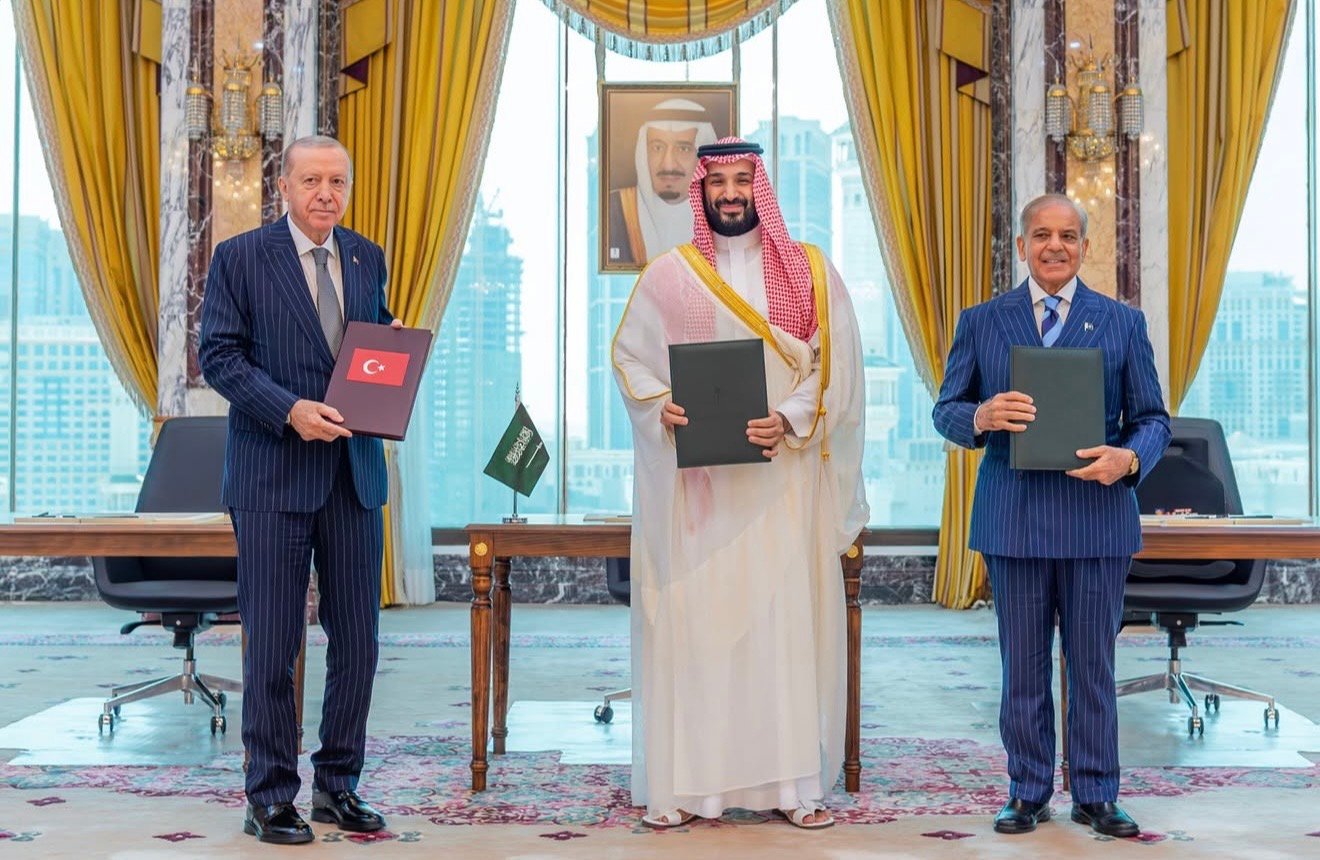
This time, the foreign policies of three Islamic countries are not being influenced, as Washington is not holding the pen. In Mecca, Pakistan, Turkiye, and Saudi Arabia signed a defence agreement and claimed, “An attack on one is an attack on all.” But is it a genuine shield or just a paper promise?
The answer is yet confidential, as the clauses of the pact have not been disclosed. But it is a clear nod to collective defence. This pact was signed amid the grinding warfare between Iran and a US-Israel coalition. The security of many countries was at risk, so there was a burgeoning urge for a new defence pact.
To fathom the pact, knowing the potential of the players is essential. KSA has the oil money and strategic geography, as the Persian Gulf is to the east and the Red Sea is to the west. King Faisal Air Base of Saudi Arabia is just 125 miles away from Eilat and 275 miles away from Tel Aviv. The religious significance of Mecca and Medina also boosts the stature of KSA. The key force behind the agreement is Saudi Arabia’s will to reduce its dependence on a single security guarantor.
The transcontinental country, Turkiye, has expertise in the realm of drones, missiles, sensors, and electronic warfare. In northwestern Turkiye, a vital 38-mile waterway, the Dardanelles Strait, lies. The importance of straits cannot be denied, especially after the Iran-USA war. The Dardanelles Strait is a busy global choke point and a major shipping route for Russia and Ukraine. Turkiye’s location and defence industry have the lethal combination that can be fruitful for all the members of this pact in case of any conflict.
Pakistan, with its battle-tested military and nuclear weapons, is an important player and security guarantor of this pact. Operation Bunyan-un-Marsoos was the turning point for Pakistan’s global image. Ironically, had India not staged its alleged false-flag operation, Pakistan would not have had the opportunity to respond and elevate its standing internationally—a remarkable own goal by India. Other than this, if Bangladesh joins this pact, then it would be very alarming situation for India. Pakistan’s presence on Siliguri corridor will make it more critical.
The collective strength of the members of this pact, 1.4 million active personnel, 3,415 aircraft, 646 tanks, and 344 naval assets, with a roughly $124.4 billion defence budget, is a formidable deterrent for its adversaries. Joint military exercises and defence industry cooperation will bolster the strength. Ministerial coordination groups will keep the defence policies aligned, and intelligence sharing among the member countries will provide the understanding and preparedness for the lull before the storm.
There were voices globally claiming that this pact is a Sunni axis, especially against Iran. The most strident voice was from the Indian media. India, a habitual false claimer, is locked in a cycle of diplomatic and geopolitical recidivism. The Mecca Joint Defence Agreement is not against any Muslim country. The ones who must be afraid of it are thinking of making alliances against this pact before its presence.
The “Hexagonal Alliance,” a concept by Israeli Prime Minister Benjamin Netanyahu, was announced on February 22, 2026. It’s an anti-Muslim bloc and will comprise Israel, India, Greece, Cyprus, the UAE, and Ethiopia. This concept is mainly against Turkey, Pakistan, Egypt, and Saudi Arabia. Iran is not included in it, as Israel seems to believe that Iran has collapsed. Israeli President Herzog’s visit to Ethiopia and PM Modi’s visit to the fatherland, after the announcement of this concept, were part of the same series of events.
The Mecca Pact is currently open to other nations. The President of Turkiye, Recep Tayyip Erdogan, said that Egypt can also join it. Egyptian Foreign Minister Badr Abdelatty confirmed that Egypt is “seriously considering joining” the pact and that the relevant authorities are currently examining it. This shows a high chance of Egypt joining the Mecca Pact. If Egypt joins, then it will be a matter of strategic importance for all members. Israel lies northeast of Egypt. Egypt’s military is one of the strongest in Africa. Egypt is an important route that links the Mediterranean, the Red Sea, North Africa, and the Gulf region. The Suez Canal, one of the world’s busiest shipping lanes, is controlled by Egypt. The other potential members can be Bangladesh, Qatar, Kuwait, and Bahrain.
The Muslim Ummah now needs to put sectarian identity on the back burner and unite for overall well-being. The Mecca Pact is the first step towards it. It would be better to be known as a Muslim state rather than a Shia or Sunni state. The Mecca Pact is a historic milestone and reshapes the balance of power. Talks are done, the treaty is signed, and now the strength of the teeth will be determined by the future.