
Pakistan, Qatar Sign Security MoU; Qatari Minister Meets Asim Munir
Following the signing ceremony, the Qatari interior minister travelled to Rawalpindi, where he called on Field Marshal Syed Asim Munir, Chief of Army Staff and Chief of Defence Forces (COAS & CDF).

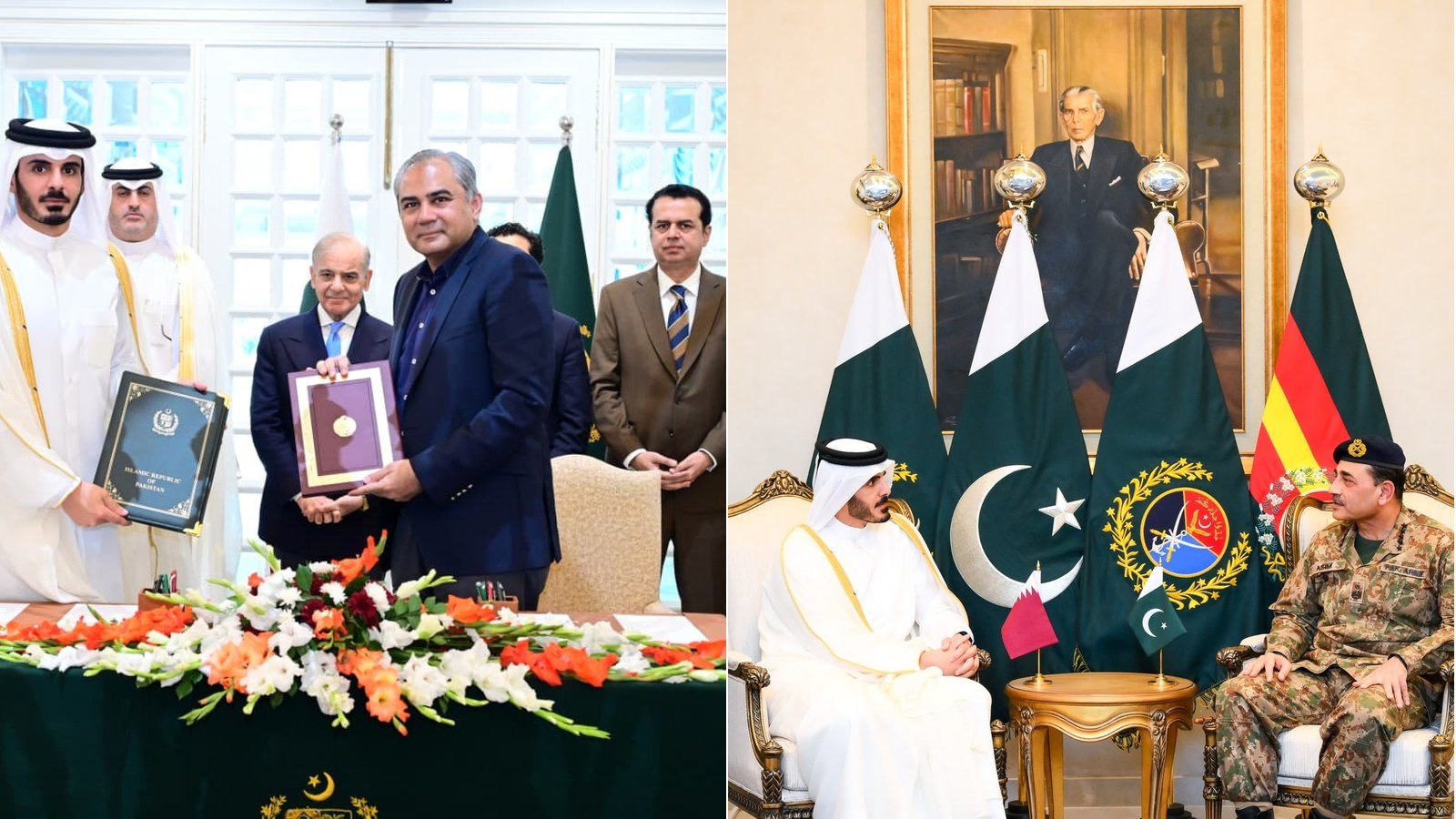
Pakistan and Qatar have signed a Memorandum of Understanding (MoU) to strengthen bilateral security cooperation, followed by a meeting between Qatar’s Interior Minister Sheikh Khalifa bin Hamad bin Khalifa Al Thani and Field Marshal Syed Asim Munir in Rawalpindi.
The agreement was signed by Pakistan’s Interior Minister Mohsin Naqvi and his Qatari counterpart, Sheikh Khalifa bin Hamad bin Khalifa Al Thani, in the presence of Prime Minister Muhammad Shehbaz Sharif.
The MoU establishes a framework for security cooperation between Qatar’s Internal Security Force (Lekhwiya) and Pakistan’s Federal Constabulary, reflecting efforts to strengthen institutional engagement between the two countries.
Following the signing ceremony, the Qatari interior minister travelled to Rawalpindi, where he called on Field Marshal Syed Asim Munir, Chief of Army Staff and Chief of Defence Forces (COAS & CDF).
During the meeting, both sides discussed matters of mutual interest, the evolving regional and global security situation, and opportunities to enhance bilateral security cooperation.
The discussions focused on strengthening collaboration in security, counterterrorism and institutional cooperation, with both sides reaffirming their commitment to further deepening bilateral relations.
The visiting Qatari minister appreciated Pakistan’s role in promoting regional peace and stability and acknowledged the longstanding fraternal ties between Islamabad and Doha.
Field Marshal Asim Munir reaffirmed Pakistan’s commitment to expanding bilateral engagement with Qatar and emphasised the importance of close cooperation in addressing shared security challenges.
The agreement and subsequent military leadership meeting reflect ongoing efforts by Pakistan and Qatar to strengthen security partnerships and expand institutional cooperation amid evolving regional security challenges.