
PM Shehbaz Urges Climate Finance Action at COP31 Türkiye
The prime minister also acknowledged Türkiye’s support during the disaster, saying the country stood shoulder to shoulder with Pakistan when it faced one of the worst humanitarian crises in its history.

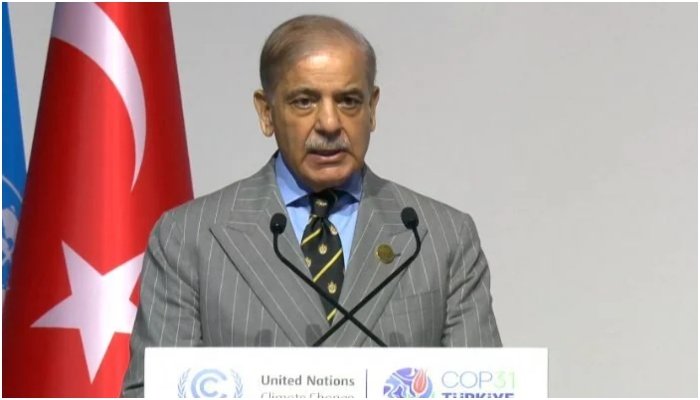
Prime Minister Shehbaz Sharif has urged the international community to fulfil its climate commitments to developing countries, stressing that nations contributing the least to global carbon emissions are among those suffering the most from climate change.
Addressing the 31st United Nations Climate Change Conference (COP31) in Türkiye, the prime minister highlighted Pakistan’s vulnerability to extreme weather events despite its contribution of less than one percent to global carbon emissions.
He recalled the devastating floods of 2022, when nearly one-third of Pakistan was submerged, affecting approximately 33 million people and causing widespread destruction across the country.
The prime minister also acknowledged Türkiye’s support during the disaster, saying the country stood shoulder to shoulder with Pakistan when it faced one of the worst humanitarian crises in its history.
Shehbaz Sharif said Pakistan remained committed to environmentally friendly policies and stressed that tackling climate change required concrete action at the international level.
He called on the global community to honour its commitments to developing nations, particularly those facing severe climate-related challenges despite their limited contribution to global emissions.
COP31: Global Climate Negotiations in Türkiye
The 31st Conference of the Parties (COP31) to the United Nations Framework Convention on Climate Change (UNFCCC) is being hosted in Antalya, Türkiye, bringing together world leaders, policymakers and climate experts to discuss international efforts to address global warming.
The conference provides a platform for countries to review progress on climate commitments, discuss emission reductions and negotiate financial support for nations vulnerable to climate change.
Climate finance remains a major concern for developing countries, which have repeatedly called for greater access to funding to strengthen disaster preparedness, build climate-resilient infrastructure and transition towards cleaner energy.
Under the Paris Agreement, countries are expected to strengthen their efforts to limit global temperature increases and support vulnerable nations in adapting to the impacts of climate change.
For Pakistan, the discussions are particularly significant because the country continues to face recurring floods, extreme heat and other climate-related disasters.
Pakistan’s Climate Priorities
Ahead of the summit, Pakistan’s Ministry of Foreign Affairs said Prime Minister Shehbaz Sharif would highlight the country’s efforts to expand solar energy and renewable power generation as part of its transition towards a cleaner and more resilient economy.
Pakistan also planned to emphasise improved disaster preparedness and early-warning systems to reduce the impact of future climate-related emergencies.
The government has consistently called for predictable, adequate and accessible climate financing to help developing countries strengthen their resilience without placing additional financial pressure on their economies.
The prime minister’s message at COP31 reinforced Pakistan’s position that international climate commitments must translate into practical action, particularly for countries already experiencing the consequences of global warming.